Supercontinuum generation is a nonlinear optical phenomenon when spectrum of a high intensity short pulse expands hundreds or thousands of times as it travels through a nonlinear medium [1]. One of the main applications of photonic crystal fibers (PCFs) is their usage as a nonlinear medium for supercontinuum generation, which in turn can be used in spectroscopy, frequency metrology and optical coherence tomography [2-3]. Numerous research about supercontinuum generation in PCFs have been performed, this process is not fully understood.
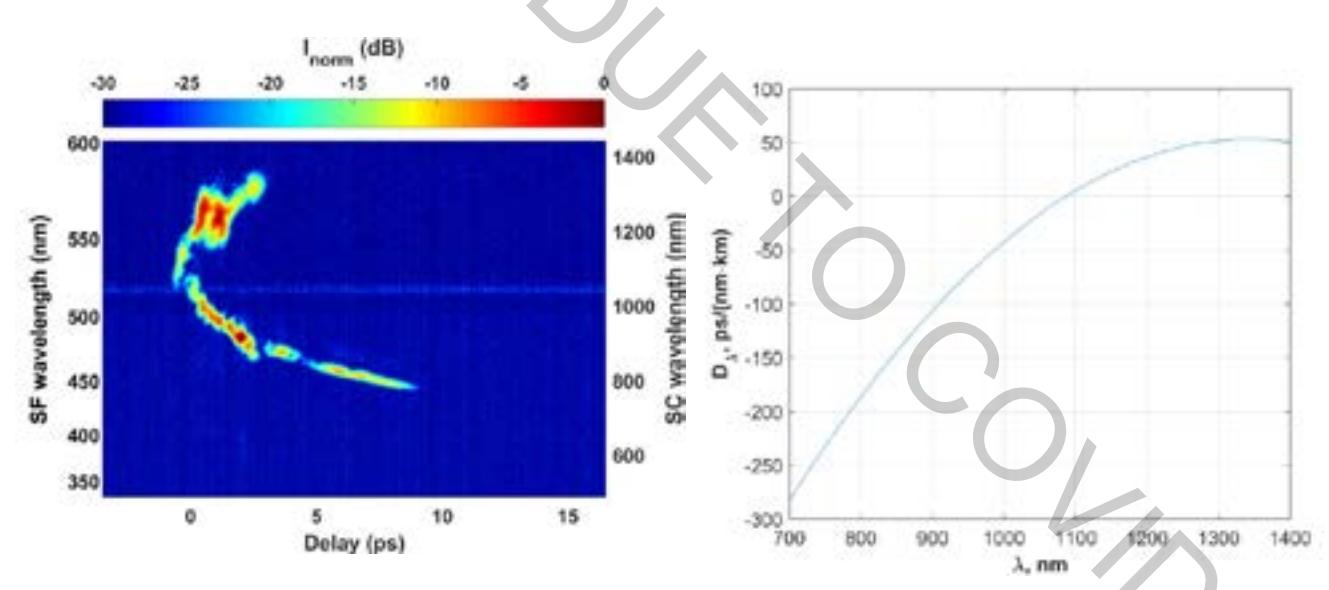
The goal of this research was to investigate supercontinuum generation in polarization-maintaining PCF and determine its group velocity dispersion (GVD). An optical setup for the measurements was constructed where 1030 nm wavelength, 76 MHz repetition rate and 90 fs duration pulses, generated by an Yb:KGW laser oscillator. A burst of two pulses was created using a setup consisting of a beam splitting into two parts, one of which was used as a reference pulse for cross-correlation frequency-resolved optical gating (XFROG) measurements and the other was used for pumping of supercontinuum generation in polarization-maintaining PCF. In addition, we also used a recently demonstrated technique [4] to estimate GVD of the investigated PCF using measured XFROG traces.
The results indicate that XFROG traces differ slightly when horizontal, vertical or intermediate (45°) polarization pump pulses were used: there are only slight changes in the intensity of the individual components of the supercontinuum spectra. The analysis of the XFROG traces and calculated results indicate that polarization-maintaining PCF GVD curves for the pulses of different polarizations have almost no differences. In XFROG trace we can see the bending point which corresponds to the zero group velocity dispersion wavelength (ZDW). For both horizontal and vertical polarization the ZDW wavelength is 1087.4 nm. This shows that the GVD of this polarization-maintaining PCF differs so little for the perpendicular polarization pulses, that it cannot be distinguished by the measurement technique which was used.