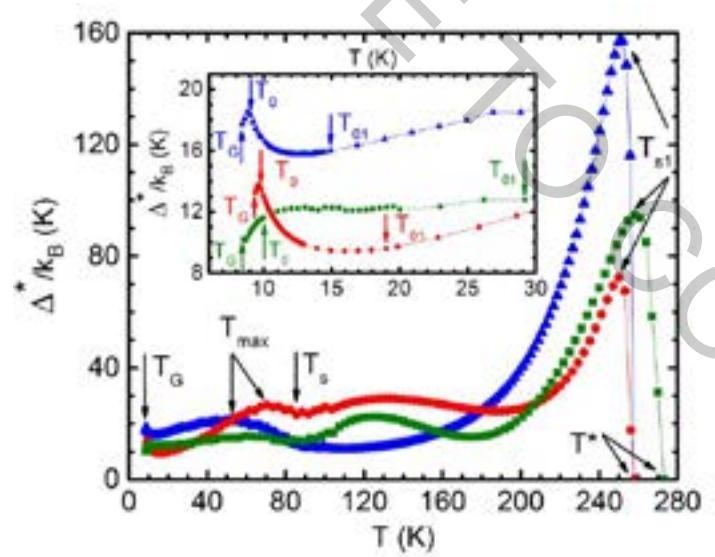
The temperature dependence of the excess conductivity $\sigma'(T)$ [1, 2] in three polycrystalline samples of the FeSe0.94 superconductor prepared by various technologies [3] was studied. Obtained from the measurements, the temperature dependences of the parameter $\Delta^*(T)$ which in cuprates is associated with a pseudogap, were analyzed in the model of local pairs. At high temperatures, all three samples exhibit a high narrow maximum $\Delta^*(T)$ at $T_{s1} \sim 250$ K, typical of magnetic superconductors. Below $T \approx 225$ K, the dependences $\Delta^*(T)$ become different. In almost the entire temperature range below Ts1, sample S2, prepared by the solid-state reaction method and not containing impurities, shows $\Delta^*(T)$ typical of Fe-pnictides. An exception is the interval from the temperature of the structural transition $T_s = 85$ K to $T_c$, where $\Delta^*(T)$ exhibits an atypical broad maximum. An analysis of the obtained dependence suggests the discovery of a pseudogap in this FeSe0.94 sample below Ts. Samples S1 containing 4 wt.% Ag and S3, with a nominal composition, but containing non-superconducting inclusions of the hexagonal phase, both obtained by partial melting, show identical $\Delta^*(T)$, but different from S2. They reveal a number of features that correlate with temperatures at which features are observed on M(T) and the Hall coefficient $R_H(T)$ changes sign several times with decreasing T, indicating a change in the type of charge carriers in FeSe. The dependence $\Delta^*(T)$ of sample S3 below Ts has practically no maximum, since non-superconducting impurities of the hexagonal phase prevent the formation of paired fermions in S3 near Tc. As a consequence, S3 has a minimum density of local pairs $\langle n_{\uparrow} n_{\downarrow} \rangle = 0.26$, determined by comparing $\Delta^*(T_G)/\Delta_{max}$ near Tc with the Peters – Bauer theory [4], and the dependence $\Delta^*(T)$ does not follow the theory. S1 has a maximal $\langle n_{\uparrow} n_{\downarrow} \rangle = 0.47$, most likely due to the influence of Ag impurities. S2 does not contain impurities, and found $\langle n_{\uparrow}n_{\downarrow}\rangle \approx 0.3$ is the same as in YBa2Cu3O7-δ [5]. Importantly, both dependencies $\Delta^*(T)$ for S1 and S2 follow the theory in a wide temperature range.