Rare earth elements (REE) based materials have wide application in many fields of technology such as screens in monitors or cell phones, telecommunication, lasers, medicine, scintillators and LED lamps. Especially lanthanides ions have remarkable optical properties due to their distinct electronic structure. They are characterized by [Xe] core, partially filled 4f shell and outer shells that screen 4f shell from the influence of external ions.
Recently conducted measurements of europium ions in glassy matrices have shown that the synthesis conditions (in particular time, temperature and melting atmosphere) significantly affect the luminescence spectrum of these materials by changing the ratio of Eu2+/Eu3+ ions, and thus result in a continuous spectrum free of sharp emission lines [1]. It is worth emphasizing that the synthesis process called melt-quenching is extremely simple and cheap to implement, unlike some sophisticated methods used to achieve a similar goal [2].
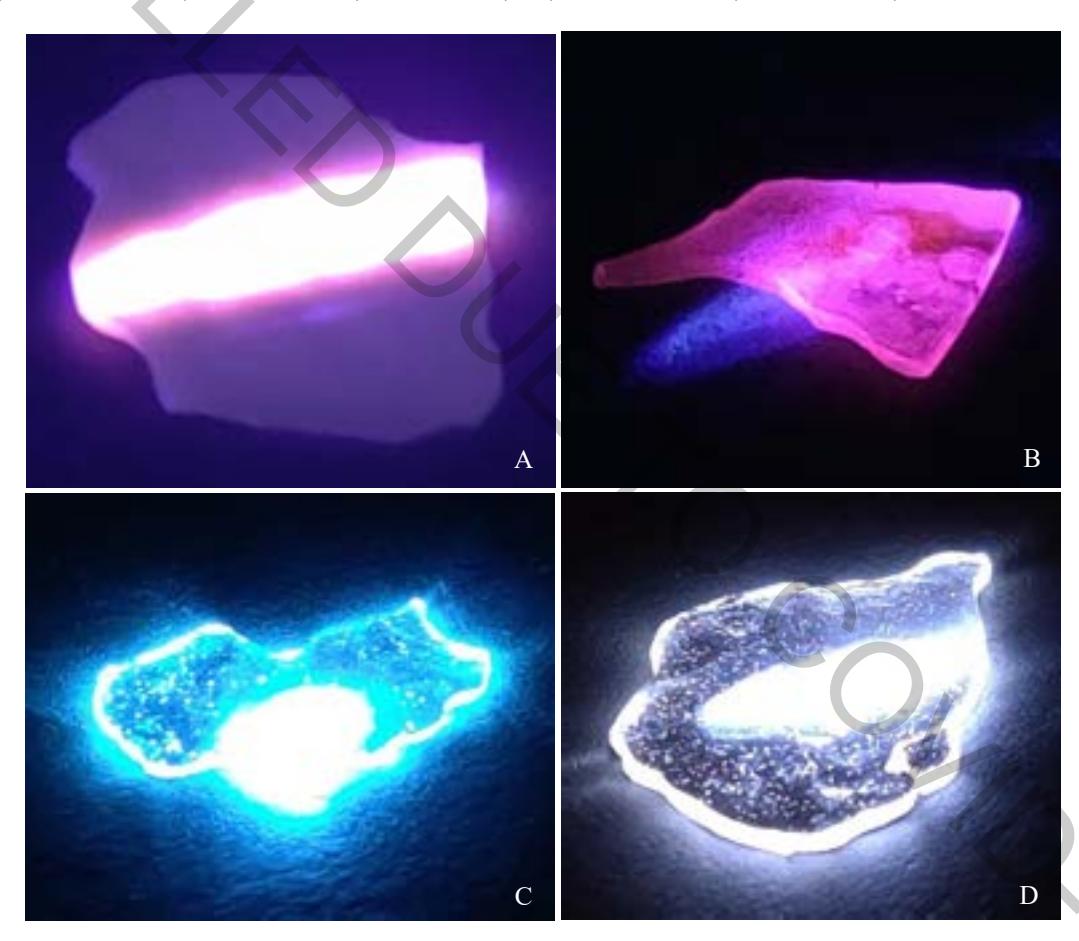
Considering all above the next step in this research was to investigate influence of excitation wavelength on the samples photoluminescence. Results for four samples will be presented. Their nominal formulas and syntheses conditions are as follows: Na2Al2(BO3)2F3 1% Eu2O3 (15 min, 1200°C) – A, Na3Al2(BO3)3 1% Eu2O3 (15 min, 1200°C) – B, Na3Al2(PO4)2F3 1% Eu2O3 (15 min, 1200°C) – C, Na3Al2(PO4)2F3 1% Eu2O3 (5 min, 1200°C) – D.