
Cross-linking starches most used in the paper and glue industry. Crosslinking occurs when a cross-linking agent introduces intermolecular bridges between polysaccharide macromolecules. Cross-linked starches are resistant to high temperature, low pH, and higher shear, and they also improve viscosity and textural properties of the native starch. Cross-linking granular starch reinforces hydrogen bonds holding the granule together. Various agents are used to crosslink native starch for example epichlorohydrin (EPI). The efficiency of the starch crosslinking reaction depends on the crosslinking agent concentration, temperature, reaction time, pH and botanical origin [1]. The purpose of the work was evaluate the epichlorohydrin starch cross-linking methodology, taking into account the starch botanical origin, granule size and suspension concentration, and optimize and predict the cross-linking process.
The purpose of the work potato, wheat, tapioca and corn starches was mixed by the reaction with sodium hydroxide solution and crosslinking agent EPI, whose the molar ratio of the AGU : EPI : NaOH : H2O was 1 : 0,01 : 0,012 : 10 . The reaction mixture was maintained the temperature at 45°C for 1 h, 3 h, 5 h, 24 h, 48 h and pH 10. To end the reaction, added 1M solution of HCl to pH 5. Later reaction was filter, washed with distillation water and dried at 105°C.
| Starch | Reaction time(h) | ||||
|---|---|---|---|---|---|
| 1 | 3 | 5 | 24 | 48 | |
| Degree of crosslinking (%) | |||||
| Potato | * | 97.8±1.4 | 98.0±1.3 | 94.5±2.0 | 98.5±1.2 |
| Wheat | 23.1±3.6 | 74.2±4.3 | 89.4±3.5 | 94.2±1.2 | 92.7±1.5 |
| Tapioca | 14.9±2.4 | * | 90.7±1.1 | 97.8±2.1 | 97.0±1.8 |
| Corn | * | 83.7±2.1 | 97.7±1.4 | 96.2±2.6 | 97.2±2.4 |
* - Values are obtained by using the starch degree of determination method, which may be inappropriate for the low degree of estimation
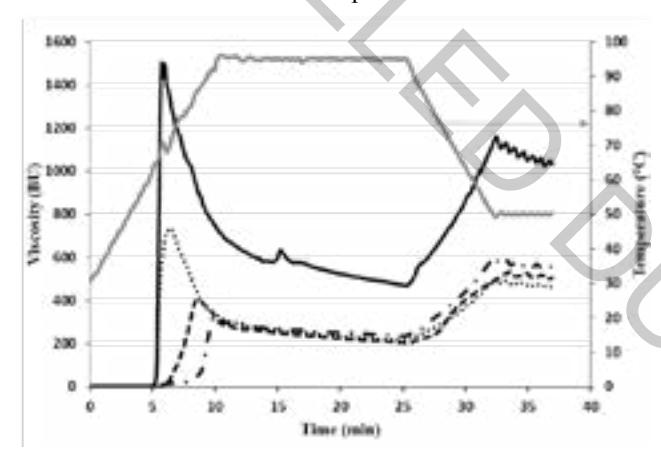
Rheological properties and crosslinking degree of starch and cross-linked starch of different botanical origin were determined. The rheological properties - degree of cross-linking of starch different botanical origin was determined by estimating viscosity parameters of aqueous slurries (8 % starch and water suspension) of modified starches according the procedure by using a Micro Visco - Amylo - Graph (Brabender, Germany). Controlled heating-and-cooling cycle under constant shear: heating from 30 to 95 °C at a heating rate of 6.5 °C/min. Viscoamylograph of various botanical origin starch from control sample viscosity is different as demonstrated in scheme in Fig. 1. The degree of crosslinking was estimated using the equation (1) [2] and degree of crosslinking is demonstrated in the table in Table. 1
$$ \frac{A-B}{A} \cdot 100\% \tag{1} $$where A is the peak viscosity in Brabender units of the control sample (0% EPI) and B is that of the crosslinked starch sample.
The degree values of crosslinking are obtained by using a cross-linking methodology which may be inappropriate to calculate the low crosslinking degree. However, the rheological properties indicate that, as the starch crosslinking reaction time increases, the crosslinking degree increases, meaning the starch paste viscosity decreases, as starch forms a crosslink starch macromolecules.