
Silver nanoplates (AgNPls) are widely utilized in biosensing due to sensitivity of localized surface plasmon resonance (LSPR) frequency to ligand environment of AgNPls [1]. Recently we have developed a technique to obtain monolayers of laterally-oriented AgNPls through electrostatic self-assembly on the surface of thin (~20 nm) film of copolymer containing tertiary amino groups (TAGs) [2]. This method allows simultaneous optical spectroscopic and TEM- investigation of as-deposited AgNPls. The aim of current work is to determine kinetic parameters of deposition of AgNPls onto thin polymer films and their arrangement on it.
Syntheses of AgNPls, poly(ethylmethacrylate)-based copolymers with 10, 25 and 50 mol. % TAGs, thin film fabrication and functionalization of AgNPls with 11-mercaptoundecanoic acid (MUA) were described in our previous work [2]. We immersed thin film of copolymer with 25% TAGs in aqueous colloidal solution of MUA-functionalized AgNPls with different optical density (2, 5 and 10 at optical path length 1 cm at LSPR peak) at pH 6.6 for 6 hours with periodical removing of the film from colloidal solution in order to conduct optical measurements. We also performed three additional experiments– using copolymers with 10 and 50% TAGs at pH 6.6 and with 25% TAGs at pH 8.5.
Inductively coupled plasma atomic emission spectroscopic and transmission electron microscopic (TEM) studies revealed that AgNPls have molar extinction coefficient $5.2\times 10^9$ M-1cm-1 on thin polymer film with optical density (OD) 0.19 at LSPR peak. Using this molar extinction coefficient, we transformed optical data to surface concentration of AgNPls on kinetic curves. The figure 1, (a) represents a TEM image of as-deposited AgNPls monolayer with OD 0.216. Point pattern analysis of AgNPls' positions by nearest neighbor analysis (NNA) shows that they are arranged chaotically.
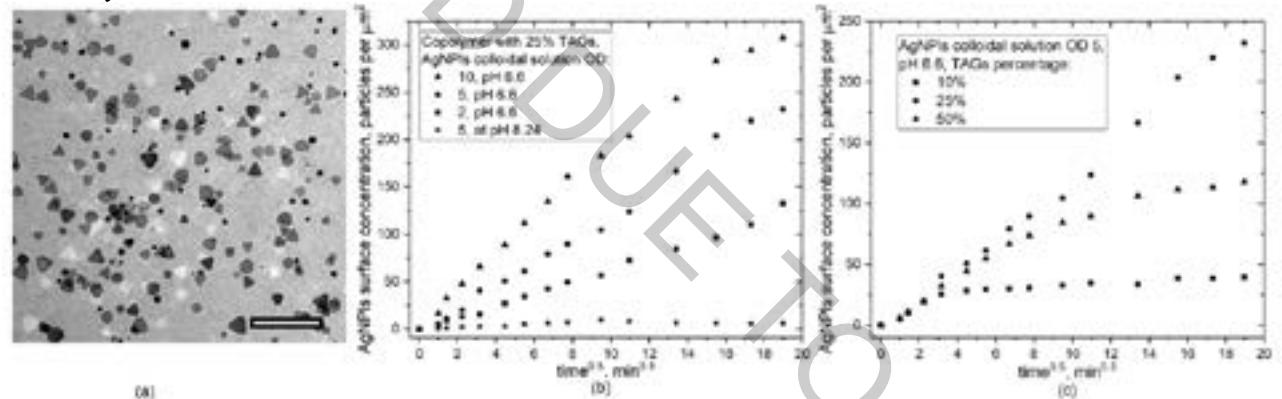
The Fig. 1, (b) shows the graphs of the average surface concentration of AgNPls (particles per square μm) on polymer film versus the square root of the immersion time obtained from AgNPls colloidal solutions with alternate optical densities. The linear relation between these parameters indicates that the most probable mechanism of deposition is random sequential adsorption, which was observed in nanoparticles deposition process recently [3]. Our calculations also revealed the linear relation between slopes of the graphs and the optical density of the AgNPls colloidal solution. This is also in good accordance with chosen model.
The dependence of AgNPls surface concentration on the TAGs percentage is more complex. After 10 min (about 3,5 min0.5) of deposition time kinetic curve for film of copolymer with 10% TAGs goes to saturation. NNA shows that the two-dimensional ordering of the AgNPls on the surface of polymer film markedly improves. Kinetic curve for film of copolymer with 50% goes to saturation, but much slower. With an increase in pH from 6.6 to 8.24 self-assembly of AgNPls becomes very low. We associate that fact with a decrease in TAGs partial charges at high pH.