Deriving physical parameters of star clusters using aperture photometry is an effective method to investigate evolution of galaxies. However, in majority cases bright background or foreground stars projecting within photometry apertures make measurement results unreliable, which in turn leads to inaccurately derived physical parameters of star clusters. In this study we aimed to improve the accuracy of star cluster photometry (the Panchromatic Hubble Andromeda Treasury survey, PHAT [1]) by correcting for background/foreground ("suspected") stars interactively.
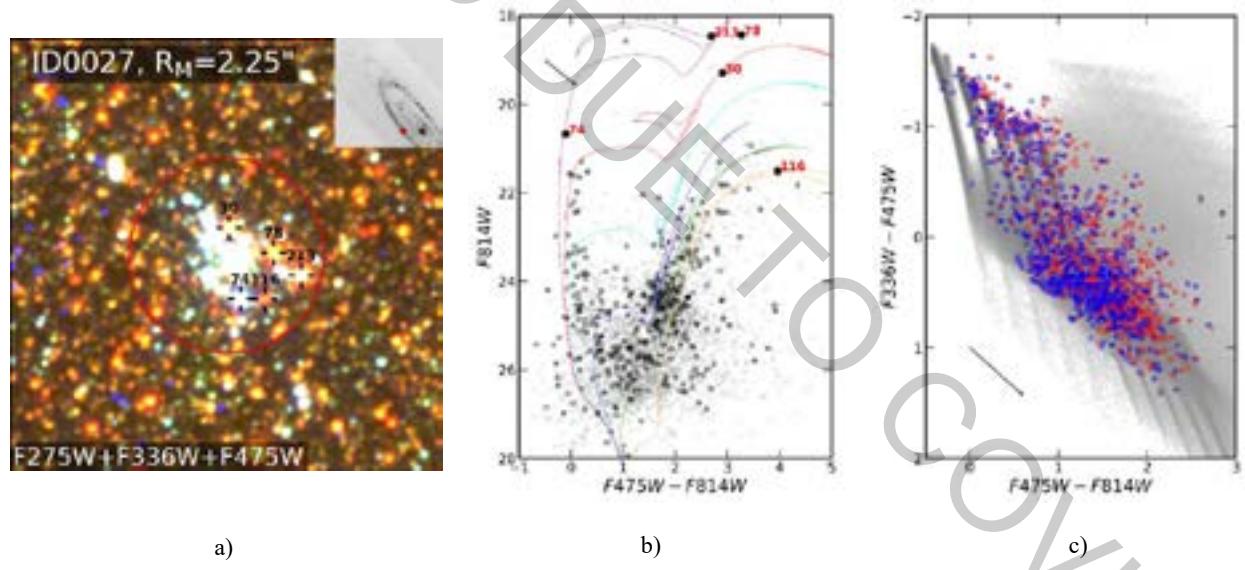
We used the subsample of PHAT star clusters analysed in [2]. For each of these 1183 clusters we located objects within their aperture radius using PHAT star catalogue [3]. To identify "suspected" stars projecting onto the cluster, we analysed cluster colour images (Fig. 1a) in various passbands and distribution of stars in the colour-magnitude diagram (CMD, Fig. 1b). We selected bright objects that likely do not belong to a given cluster based on their colours and unusual positions in the CMD. Majority of the selected "suspected" stars are red, i.e., bright objects in the infrared passbands. However, in some cases bright in the ultraviolet passbands "suspected" stars also were selected.
Quality of the PHAT cluster photometry was improved considerably by subtracting those "suspected” stars. Positions of all reduced clusters in the colour-colour diagram are shown before (red) and after (blue) subtracting of the “suspected" stars (Fig. 1c). Also, in Fig. 1c are plotted stochastic theoretical models by applying various extinction values (small grey dots). A better match of the star cluster photometry data with theoretical models in the ultraviolet and visual passbands is noticeable. However, in the infrared passbands a spread of corrected cluster photometry data increased significantly. We found that subtraction of "suspected” stars imitates interstellar extinction effects.