
Photon upconversion (UC) through triplet-triplet annihilation is a phenomenon that can be used to increase solar cell efficiency,[1] activation of drugs inside organic tissue,[2] bio-imaging[3] and others[4]. Rubrene is an excellent material for near-infrared to visible UC, since it features efficient photoluminescence (PL) in isolated phase with PL quantum yield (QY) of 100%. High PLQY enables efficient UC in solutions, but for practical applications, the solid-state UC is of higher interest. However, rubrene suffers from aggregation induced PL quenching, which hampers UC performance in the solid-state. Therefore, to diminish concentration quenching in the solid films the chemical modification of the rubrene is necessary to attain higher UCQY.
In this work, optical properties of new rubrene-based derivatives with 3,5-di-tert-butyl-phenyl substituents are reported (Fig. 1). Photophysical properties of the rubrene compounds in solid polystyrene (PS) doped films were assessed by measuring PL spectra and PLQY. In addition, sensitized UC films with high emitter concentrations were prepared and UCQY were measured. Due to sensitivity of the rubrene to oxygen, sample series were prepared in N2 environment (O2 and H2O < 0.1 ppm) and encapsulated between two glass slides using epoxy glue. To assess the degree of aggregation, rubrene derivatives were dispersed in PS matrix with increasing its concentration and PLQY was determined using integrating sphere (Fig. 1).
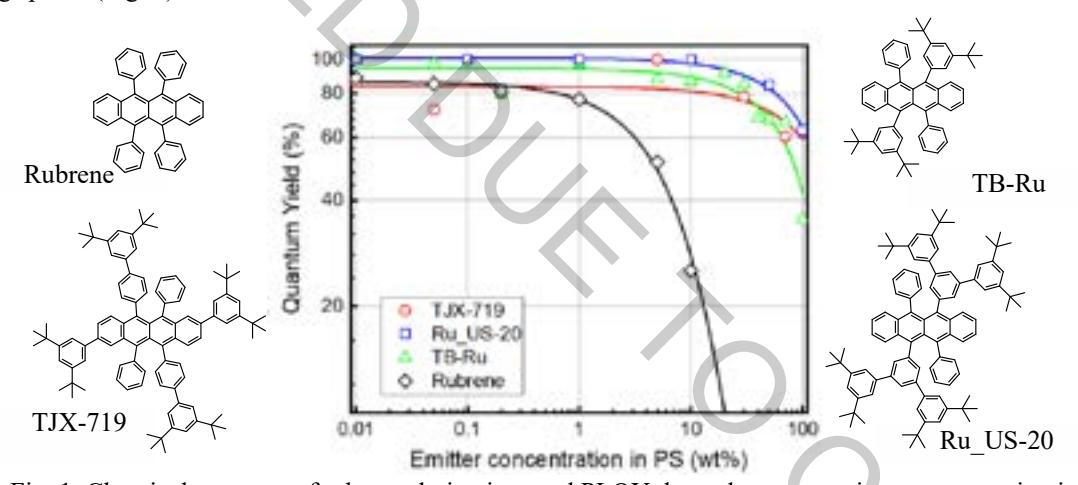
Experimental results indicate that the lowest absorption peak depends on the position of the substituents attached. Absorption band of the TJX-719 it is redshifted, while for Ru_US-20 is blue shifted as compared to unsubstituted rubrene. Absorption spectrum of TB-Ru is virtually unchanged as compared to rubrene. Generally, quantum yields of rubrene derivatives were found to be high (close to 100%) at low emitter content in the PS matrix. However, PLQY of the rubrene films experienced rapid drop with increasing emitter concentration already above 1 wt%, whereas 3,5-di-tert-butyl-phenyl substituted rubrene derivatives showed persistently high PLQY up to 30 wt% and only above this concentration slight decrease of PLQY was observed. In the neat rubrene film (at 100 wt% of emitter) PLQY drastically decreased down to 1.5%, which is ascribed to the formation of crystalline aggregates facilitating singlet fission.
4-fold higher UCQY were attained in the sensitized TB-Ru PS films as compared with rubrene due to reduced concentration quenching, however higher number of substituents in TJX-719 and Ru_US-20 resulted in reduced triplet exciton transfer rate and consequently lower UCQY.