
Development of optical components has to keep up with constantly growing lasers' pulse peak power and radiation frequency, which mean they must have higher and higher laser induced damage threshold (LIDT). Investigating and understanding the dynamics of laser damaging would help to achieve that and avoid breach of optical elements. In this experiment, ultrafast spectroscopy methods are used to observe and analyze damage and aging processes of titanium dioxide (TiO2) dielectric coating on BK7 optical glass bulk.
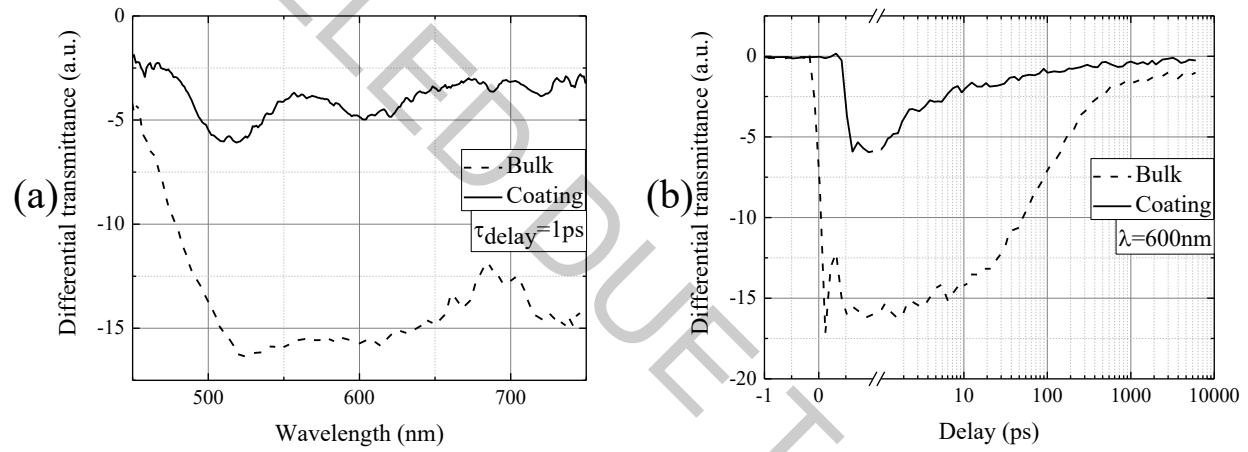
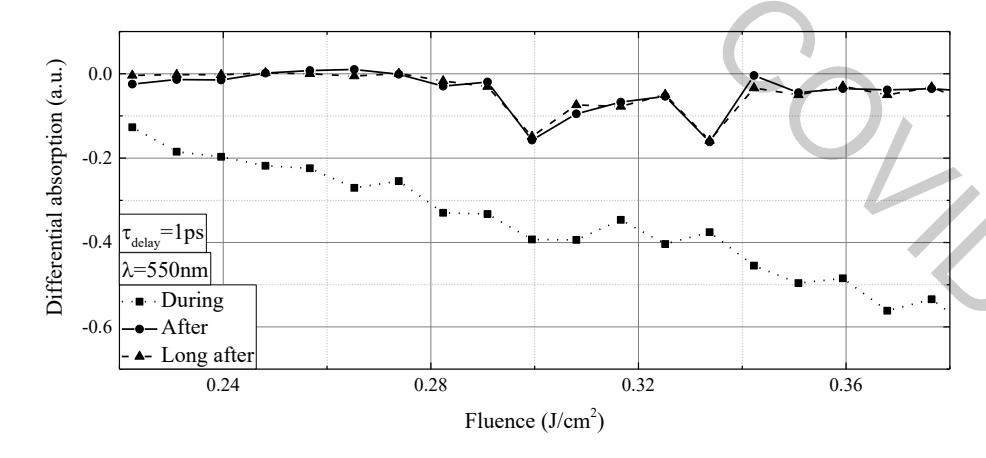
A standard pump – probe experiment was conducted to demonstrate that we can separately analyze bulk and coating of the optical element. The difference is evident in signal strength and extinction kinetics (Fig. 1(a) and (b)). Then "single-shot" method was used to detect difference transmittance spectra at the moment of excitation (During), after 1ms (After) and from 1ms to 1s (Long after) after the pump pulse. Every measurement was taken at a different location while raising beam power. Main results of TiO2 dielectric coating investigation are shown in Fig. 2. Difference transmittance dependence on pump pulse fluence shows LIDT of the sample ($F = 0.27J/cm^2$) and the dynamics of damage.
These experiments are a demonstration of laser induced damage measuring capabilities. As now we can record difference transmittance spectra in femtosecond resolution, more measurements are going to be made to determine damage mechanisms of bulk materials and coatings from their dynamics. Observing spectral similarities between different materials and coatings will help to understand the physical properties of the damage itself.