In the recent decades, a significant research interest has been invested in the field of organic light-emitting diodes (OLED). While the efficiency of these devices has been greatly improved by introduction of heavy metal based phosphorescent emitters which utilize both singlet and triplet excitons, such compounds have several drawbacks [1]. While the cost and toxicity of these materials has been addressed by the introduction of all-organic thermally-activated delayed fluorescence (TADF) materials by Adachi et al. [2], blue TADF materials still exhibit quite long fluorescence decay lifetimes due to slow triplet exciton upconversion resulting in poor OLED stability.
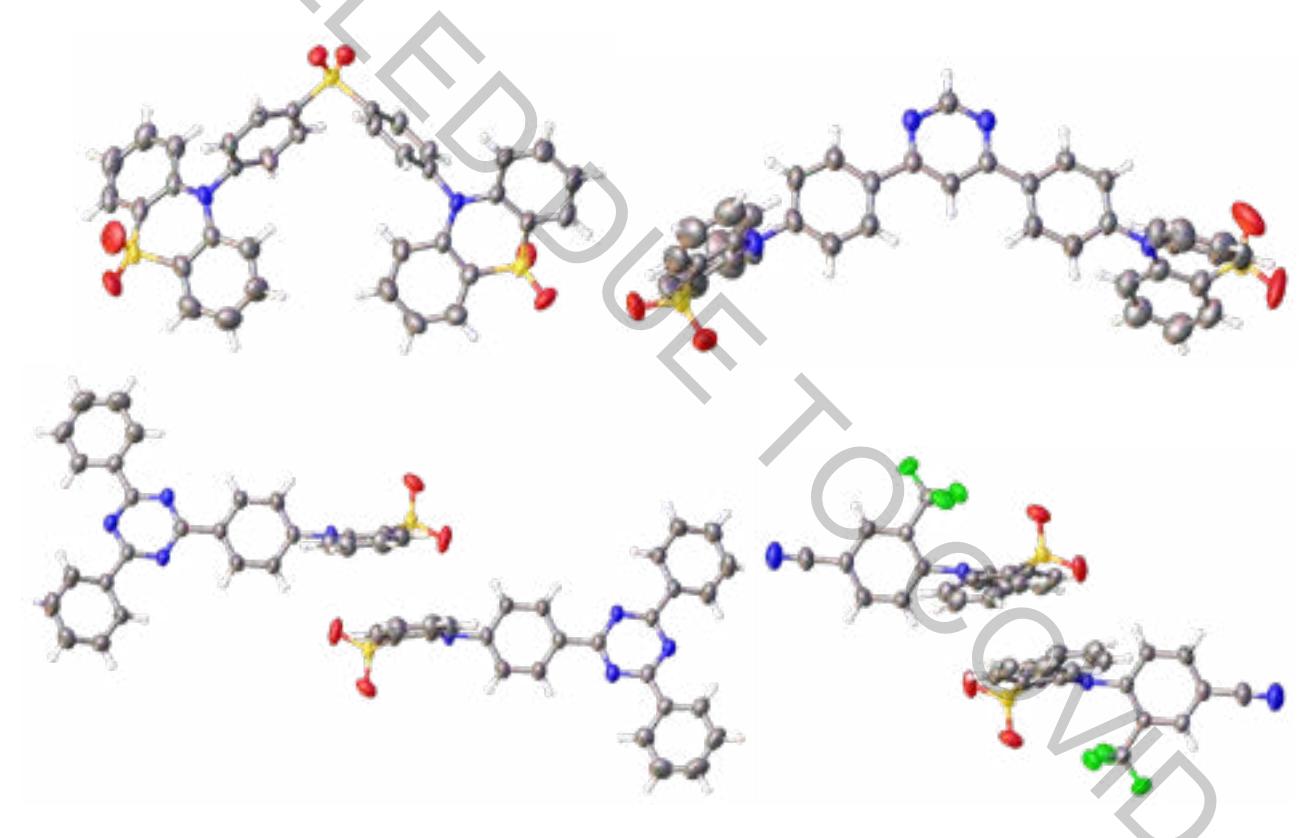
In this work we present four novel TADF materials based on utilizing phenothiazine-5,5-dioxide as a push-pull donor moeity. The materials were synthesized in a simple and cost-effective two-step synthetic procedure consisting of nucleophilic substitution followed by oxidation. Structures of the materials were investigated by single crystal X-ray diffraction analysis. Photophysical properties of materials were investigated, the materials exhibit remarkably short (<100 ns) fluorescence lifetime decays in toluene solutions while still displaying common TADF characteristics: bathochromic shift in polar media, fluorescence intensity increase in deoxygenated solutions, low $\Delta E_{ST}$ values.