Thermally activated delayed fluorescent (TADF) emitters are extremely attractive due to their potential to harvest all triplet excitons via reverse intersystem crossing (rISC) process into the singlet manifold thereby ensuring 100% internal quantum efficiency. [1] However, due to pronounced charge-transfer character of TADF compounds, there are difficulties in achieving deep blue emission. [2] Additionally, TADF-OLEDs suffer from early efficiency roll-off associated with high long-lived triplet exciton population. Therefore, TADF emitters with large rISC rate facilitating triplet up-conversion are required. [3]
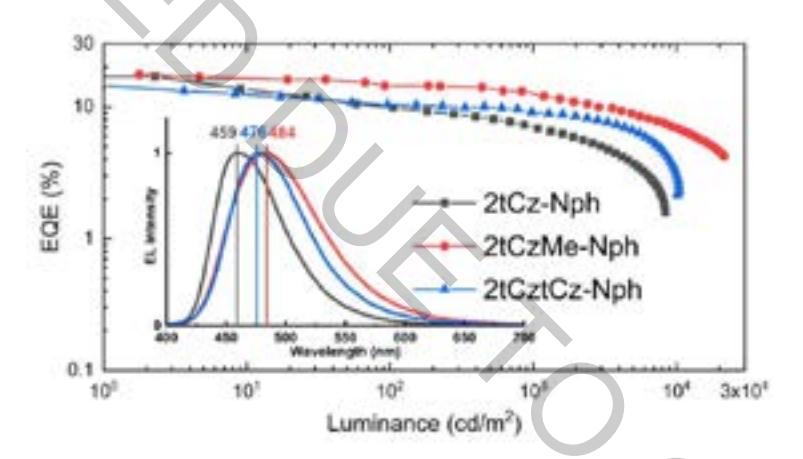
To this end, we designed new TADF emitters based on 1,8-naphthyridine acceptor and differently substituted carbazole donor groups. Photophysical characterization of the compounds revealed high photoluminescence quantum yield (up to 86%) in mCP host with large rISC rates (up to $1.1\times10^6$ s-1). We fabricated vacuum and solution processed TADF-OLEDs employing 7% naphthyridine-doped emissive layer. Devices exhibited deep blue to blue emission with CIE color coordinates from (0.14, 0.16), external quantum efficiency (EQE) of up to 17.6% and high brightness (up to 23000 cd/m2). Most importantly, due to the large rISC rates TADF OLEDs demonstrated weak efficiency roll-off. EQE characteristics of the produced devices are shown in the Fig. 1 together with their electroluminescence spectra. Obtained results indicate that 1,8-naphthyridine based emitters are promising for TADF-OLED application.