
Computer finite-elements models for describing the 3D stress-strain state of an active system "car tire-asphalt concrete" have great practical importance for road and tire industry. Also important challenge for road services and tires manufacturers is the assessment of volume damageability and wear of the tire tread and the asphalt pavement, which work in conditions of contact, mechanical and sliding fatigue. Today, there are many works dedicated to analytical and FEM simulation of the "car tire-asphalt concrete" separate system components. However, the problem of estimating 3D stress-strain state and the state of the volumetric damageability in contact interactions of asphalt and multicomponent tire with rib pattern is still not fully investigated.
In this investigate simultaneous contact interactions of the full multielement system "car tire-asphalt concrete", loaded by the various tire inner pressure $P_S$ (from 0.65 to 0.85 MPa) and radial load $F_H$ (from 6 to 10 kN) on rim were modelled using finite-element method [1,2]. The main goal of this work is determine and analyze 3D stress-strain state of the whole system and the state of volumetric damageability by maximum stress intensity $\sigma_{\text{int}}^{\text{max}}$ and damaged volume $V_{\text{int}}$ in contact interaction area of tire and asphalt concrete, where maximum stresses occur: 1) asphalt concrete, 2) tire tread and 3) rubber under radial ply [2]. Calculation of damaged volume $V_{\text{int}}$ is based on the model of deformable solid mechanics [3]. According to this model damaged volume $V_{\text{int}}$ is the volume where acting stresses $\sigma_{\text{int}}$ are greater than limiting stress $\sigma_{\text{int}}^{\text{(lim)}}$. Allowable limit stress by stress intensity $\sigma_{\text{int}}^{\text{(lim)}}$ for friction fatigue in contact zone of tire and asphalt is 0.5 MPa and for others rubber parts of tire is 1 MPa which work in conditions of mechanical fatigue.
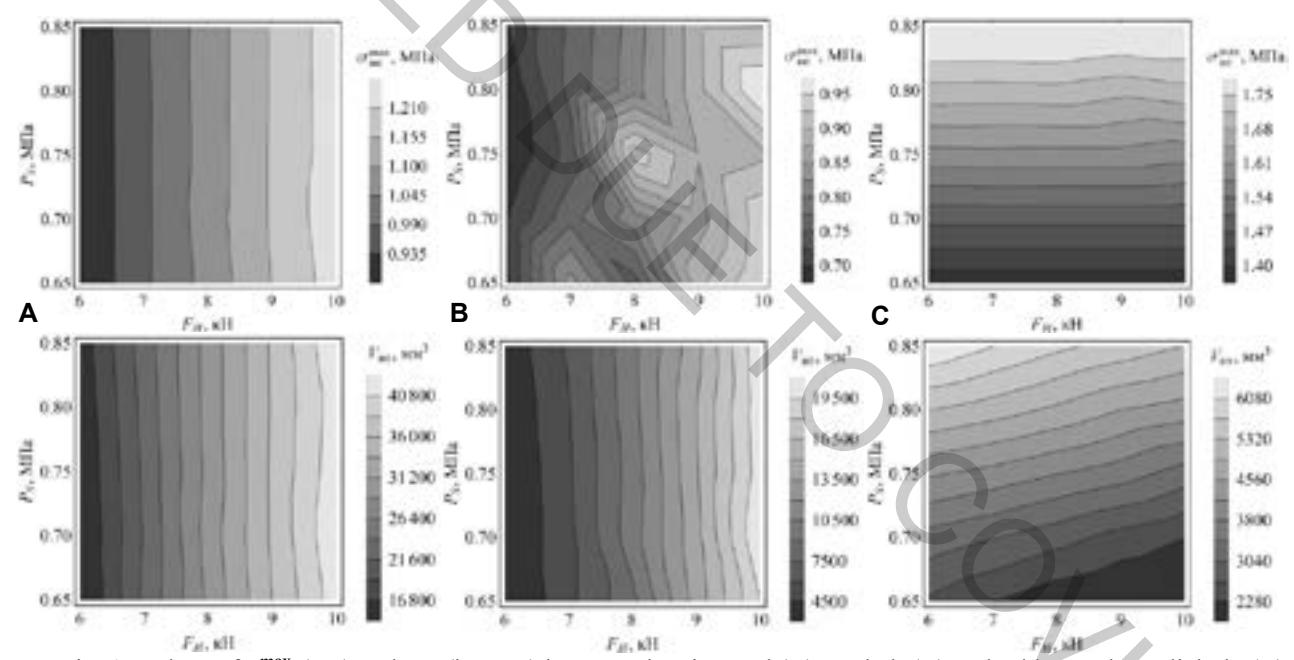
Values of $\sigma_{\text{int}}^{\text{max}}$ and $V_{\text{int}}$ in tire tread (fig. 1-a) increased to 1.4 and 2.7–3 times when the $F_H$ is increased from 6 to 10 kN and increased slightly when $P_S$ is increased from 0.65 to 0.85 MPa.
Values of $\sigma_{\text{int}}^{\text{max}}$ in asphalt (fig. 1-b) increased to 1.28–1.46 times when the $F_H$ is increased and $\sigma_{\text{int}}^{\text{max}}$ changed nonlinearly to 3–27% without an explicit dependency with local minimum and maximum when the $P_S$ is increased. At the same time $V_{\text{int}}$ increased to 6–7.5 times when $F_H$ is increased and $V_{\text{int}}$ increased to 3–27% when $P_S$ is increased. At this case system stress-strain analysis by $V_{\text{in}}$ is easier than by $\sigma_{\text{int}}^{\text{max}}$ and allows to smooth features of FEM calculations.
Values of $\sigma_{\text{int}}^{\text{max}}$ in rubber under radial ply (fig 1-c) changed slightly when $F_H$ is increased, however, $V_{\text{in}}$ decreased to 17–34%. At the same time $\sigma_{\text{int}}^{\text{max}}$ and $V_{\text{int}}$ in rubber under radial ply increased to 1.3 and 2.4–3.1 times when $P_S$ is increased. This case shown us much more influence $P_S$ on system stress-strain state at analysis by $V_{\text{int}}$ than by $\sigma_{\text{int}}^{\text{max}}$