Carbamide (CO(NH2)2), better knonwn as urea, is an organic amide, which is the final product of protein degradation in the human body. High carbamide levels in blood or body fluids can be associated with kidney failure or liver malfunction [1]. This medical reason is very important cause for finding new, fast and inexpensive methods for urea detection. Iron hexacyanoferrate (Prussian blue (PB)) is an inorganic, electrochromic compound, which is selective for several monovalent ions (Cs+, Rb+, K+ and NH4+). These ions (Cs+, Rb+, K+ and NH4+) is incorporated in the crystal lattice of PB when PB is electrochemically reduced in Cs+, Rb+, K+ or NH4+ ions containing solution [2]. Moreover, the concentration of PB reduction promoting ions (Cs+, Rb+, K+ and NH4+) affects the reduction potential of PB. For this reason, PB can be used as a signal transducer in optical and electrochemical analytical systems, such as electrochemical ion sensors [3].
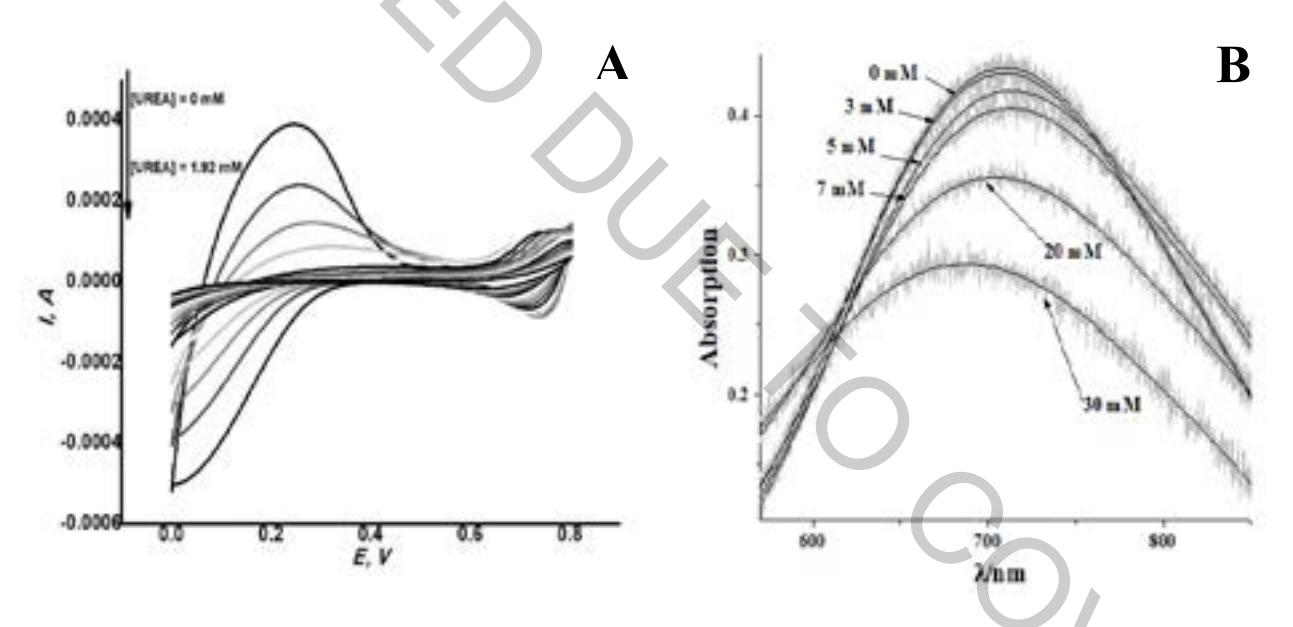
In this research concentration of urea was evaluated due to electrochromic PB selectivity to ammonium ions: the addition of ammonium ions into the electrochemical cell causes the increase of PB reduction potential (Fig. 1 A). Therefore, when the constant electric potential (0.2 V vs Ag|AgCl|KClsat) is applied to the PB coating, the increase of ammonium ions concentration causes the reduction of PB into the colorless form (Prussian white (PW)) (Fig. 1 B). During this experiment, ammonium ions were generated in the electrochemical cell by applying enzymatic urea hydrolysis (Fig. 1 B) or electrochemical oxidation of urea (Fig. 1 A). In both cases, concentration of ammonium ions was proportional to the concentration of urea.