
There are a number of methods of non-destructive testing, which are suitable for breakdown diagnostics of technical equipment, industrial machines and mechanisms, as well as eliminate defects in products manufactured. One of the main approaches is the usage of ultrasound signals as a diagnostic tool. Compared with other methods of non-destructive testing, this method has a set of important advantages: high sensitivity; low cost; safety for humans (unlike X-ray inspection); possibility of non-destructive testing without interruption of technological process; possibility to control wide range of materials. Conventional piezoelectric electro-acoustic transducers are characterized by high supply voltages, large size and high weight, high electromagnetic interference susceptibility, relatively narrow operation bandwidth []. Photoacoustic transducers are very attractive alternative to electro-acoustic transducers. In photoacoustic transducers, absorber is heated and cooled, leading to mechanical deformations, which cause cycles of pressure, or, in the other words, acoustic waves in ambient surrounding [1].
This paper describes the output characteristics of the experimental fiber-optic photoacoustic transducer with a monolayer of silver nanoparticles, previously created by the authors [2,3]. Silver nanoparticles monolayer has been deposited on the optical fiber edge using pulsed laser deposition method [3]. The average diameter of the nanoparticles is 35 nm, the mean square size dispersion is 12 nm, the density of the filling of the substrate with nanoparticles is 3.8% [4]. The photoacoustic response is observed in the frequency range of 10–18 MHz and its level is more than 12 dB higher than setup noise floor (fig. 1, left). There is no observable effect of 1 hour operation on the surface nanostructure microscopic parameters (fig. 1, right). This fact makes it possible to use such transducers as part of high-resolution technical diagnostic and non-destructive testing systems.
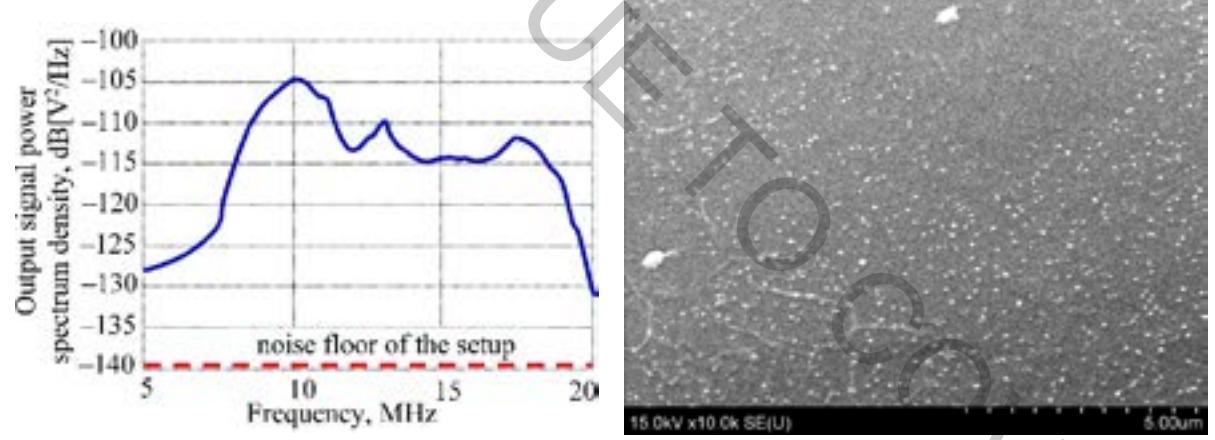
Thus, experimental fiber-optic photoacoustic converter (based on Ag nanoparticle monolayer with a gamma distribution of nanoparticles in size, diameter of 35 nm and a size dispersion of 12 nm formed at the edge of the optical fiber) it is possible to obtain reliable ultrasound generation in water in the frequency range of 10 – 18 MHz using a laser diode with fiber-optic pigtail and peak power of 40 mW.