
Atmospheric pressure plasma jets are widely studied due to their prospective capabilities to be used in plasma medicine technologies [1]. Basic applications of atmospheric pressure plasma jets are linked with that they can transfer numerous chemical and biological active species from a discharge region to a treated object. A bactericidal number of active species (reactive oxygen and nitrogen species or RONS) is efficiently generated in the case of using air as a feeding gas. [1-2].
This paper presents the results of studies of air plasma jets by atmospheric pressure glow microdischarge (APGμD) and dielectric-barrier discharge (DBD) and their spectral analysis. The electrical circuit for the generation of APGμD on direct current and the discharge chamber is show in [3]. The electrical circuit for generating a DBD jet and a discharge chamber is presented in [4]. The discharges and plasma jets formed on their basis were investigated using emission and absorption spectroscopy methods.
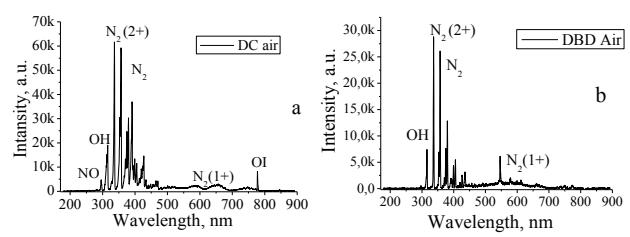
It has been shown by emission spectroscopy that the presence of the NO, OH, N2 (2+), N2 (1+), N2, OI bands is characteristic of the APGμD spectrum (Fig. 1a), the main difference between the discharge spectrum and the jet spectrum is the presence of a band NO2 spectrum due to the three-particle chemiluminescent reaction NO + O2 + M → NO2 + M. The characteristic DBD spectrum (Fig. 1b) includes OH, N2 (2+), N2 (1+), N2, and the discharge has such a low luminescence intensity that the resulting plasma jet does not emit in the range of 200-900 nm.
Using FT-IR spectroscopy was shown that, in the range of 600–4000 cm-1, APGμD jet in air are characterized by the presence of NO, NO2, HNO2, N2O bands (Fig. 2a), while DBD jets in air are characterized by the presence of O3 and N2O bands (Fig. 2b). The concentration distribution along the axis of the jet is shown in Fig. 2c and 2d. In treatment zone of microorganisms (4 cm from the anode), the concentrations of RONS are: NO – 35 ppm, NO2 – 20 ppm, HNO2 – 9 ppm (for APGμD jet), O3 – 2 ppm (for DBD jet). The concentration of the N2O molecule is about 1 ppm for both cases.

The inactivation ability of the obtained plasma jets was studied by determining the diameter of the zones of inhibition. For this, a culture of S. aureus and E. coli was seeded in Petri dishes with an initial concentration of 105 CFU/ml, after which treatment with both plasma jets was carried out at different exposure times. During an exposure of 10 minutes on S.aureus, it was noted that for DBD jets in plasma, S.aureus inactivation is faster (101 CFU/ml left in 7 minutes of treatment) than for APGμD jets in plasma (101 CFU/ml left in 10 minutes of treatment). The opposite situation was observed for E. coli, in this case it is most efficient to use the APGμD air plasma jet.
This make it possible to more efficiently select the conditions for the generation of the required composition of bactericidal components for a specific problem.
The work is partially supported by the grant of BRFFR F19RM-018.