Last decade, light-emitting diodes based on organic molecules (OLED), quantum dots (QLED), and perovskites (pero-LED) aspire to supersede well established, however, hazardous and expensive AIIIBV technology. The outstanding performance was achieved for diodes emitting green and red light, whereas high efficiency and long-term stability of blue electroluminescent (EL) devices still remain challenging. The main drawback of organic blue light-emitting diodes stems from the bimolecular triplet-polaron annihilation (TPA). According to quantum spin statistics, singlet "bright" excitons undergoing fast radiative decay and triplet "dark" excitons experiencing non-radiative relaxation via defect states are formed with a ratio of 1:3, thus, the EL efficiency cannot exceed 25% [1]. Triplet excitons can transfer their energy to polarons that results in breaking chemical bonds in the molecules and the formation of defects which deactivate singlet excitons and decrease the EL efficiency [2].
On the contrary, cesium lead halide perovskites (CsPbX3; X = Cl, Br, I) possess "bright" triplet excitons [3] which energy can be altered from 1.72 to 3.1 eV by halide anion exchange in the crystal lattice. For this reason, cesium lead mixed-halide (Br3-xClx, $1 \le x \le 3$) perovskites yielding narrow-band emission in 410–480 nm range are promising candidates for the development of blue light electroluminescent devices.
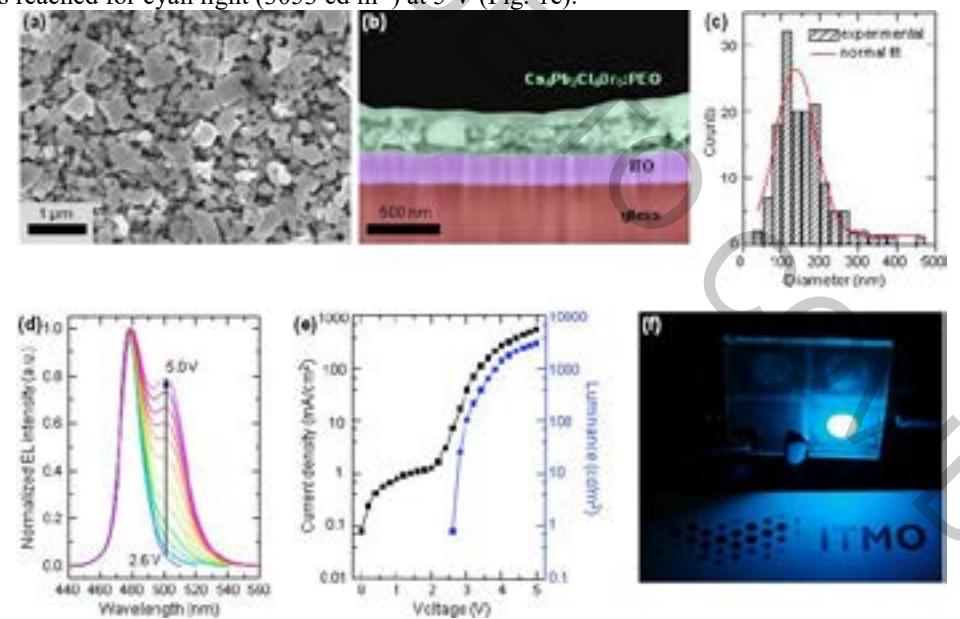
A single-layer (SL) perovskite LED includes a glass substrate with ITO conductive layer, active perovskite-polymer layer and Ga-In eutectic electrode. The active layer is deposited on substrate by spin-casting solution technique in a N2-filled glovebox. Then, substrates with perovskite-polymer thin film are evacuated in a vacuum chamber and subsequently annealed at high temperature in air. As a result, perovskite-polymer films consisting of tightly packed grains covered with polymeric matrix is formed (Fig. 1a,b). Normal fit of the grains diameter distribution shows a maximum at 135 nm (Fig. 1c). SL-LEDs based on such films exhibit temporally stable and narrow EL peak ($\lambda_{\text{em}}$ = 478 nm, FWHM = 14 nm) at bias not exceeding 3.2 V, whereas noticeable segregation occurs when applied voltage increases up to 5 V (Fig. 1d). Thereby, pure blue emission has maximum luminance of 217 cd m-2 at 3.2 V and the maximum value is reached for cyan light (3053 cd m-2) at 5 V (Fig. 1e).