
The whispering gallery modes (WGM) resonators are based on spherical objects, which are made from optically transparent materials, and are capable of maintaining an circling optical wave inside a sphere, using total internal reflection. If there is a light source which supplies the sphere with constant intensity, the wave moving along the perimeter of sphere starts to interfere constructively. In this case the resonance happens, which is called whispering gallery mode (WGM). When there is a change in temperature, it changes the radius of WGM resonator, and that results in change of refraction coefficient, which results in change of resonance and intensity. The current work explores the possibility of using temperature changes to measure polymethyl methacrylate (PMMA) WGM microsphere resonator quality factor (Q) and thermal expansion parameters. Different diameter and material spheres are used in the experiments for equipment testing and calibrating.
The two main parameters which determine the WGM microresonator resonance peak change with temperature are the linear thermal expansion coefficient $\alpha$ and the optical index of refraction change with temperature $\beta$ (thermorefractive coefficient) which also changes with the wavelength of used light. The combined $\alpha$ and $\beta$ coefficient formula could be written as Eq. (1):
$$\frac{\Delta\lambda}{\lambda} = -(\alpha + \beta)FWHM\tag{1}$$
where FWHM is the resonance full width at half maximum, measured in temperature degrees, which is obtained from the periodic resonance signals acquired by changing a temperature. $\Delta\lambda / \lambda$ is the relative resonance peak shift per Kelvin. In our measurements we have a simplified case where laser wavelength is constant and resonance tuning is induced by changing temperature.
From the obtained traces peak width and repetition free spectral rage was measured manually and Q-factors were calculated for several different size PMMA micro resonators, see Fig. 1
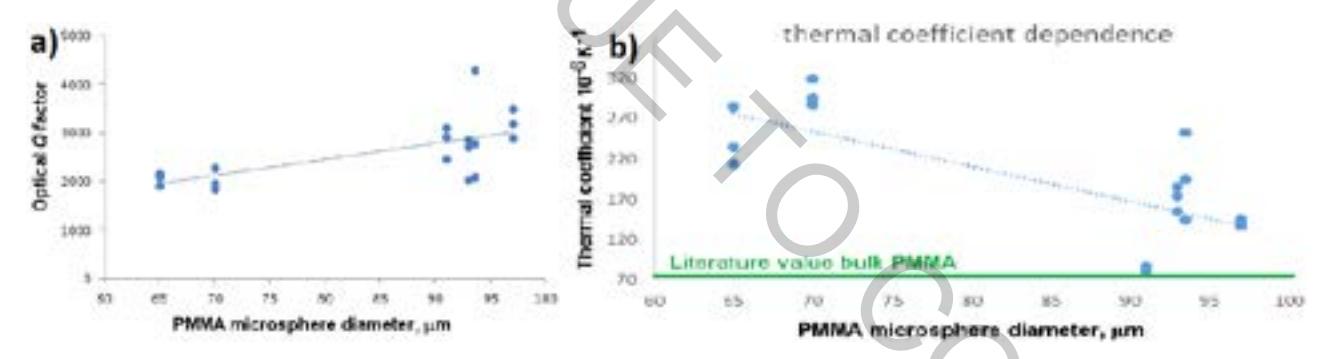
Our result show that thermal coefficient slightly increases for smaller resonators probably. For best results of thermal coefficient, would, be if the WGM micro resonator size would be around 130-140μm, where the results come close to their bulk material value of 80*10-6/K[4] .
The performed experiments show a very simplified way of measuring Q-factors for WGM micro resonators and determining thermal coefficient. This opens up a window for new measuring tool and method deign, that would be very useful for people working with WGM resonators [5]. For example a temperature sensor can be built employing the fact that different size resonators have different periodicity of resonances.