Electroactive organic compounds are widely used in the production of organic light emitting diodes (OLEDs). OLED technology is used to the manufacture of flexible displays, smartphones and lighting [1]. Thermally activated delayed fluorescence (TADF) materials have attracted considerable attention due to the ability to achieve 100% internal quantum efficiency [2]. The TADF mechanism is only possible when the energy levels of T1 and S1 are very close to each other, so that's why endothermic reverse intersystem crossing (RISC) process can be activated by thermal motion of the atoms [3]. Because the T1 $\rightarrow$ S0 jump is forbidden, these triplet excitons are converted into singlet capable of emitting a quantum of light, thus increasing the quantum efficiency of luminescence [4]. Many studies have shown that the donor-acceptor structure is one of the best options for developing TADF emitters. Current emitters are designed based on a donor-acceptor model with high spatial separation of highest occupied molecular orbital (HOMO) and lowest unoccupied molecular orbital (LUMO) orbitals [5]
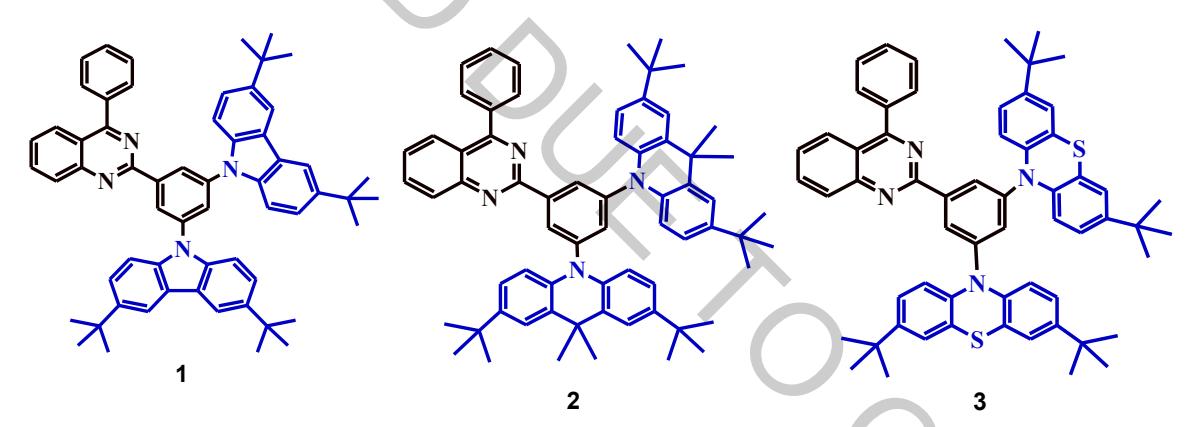
In this work, we present quinazoline-based emitters bearing donor-acceptor-donor electronic structure. Quinazoline is a planar aromatic heterocyclic compound with a fused benzene and pyrimidine ring structure. Due to its conjugated and condensed structure, the quinazoline compounds exhibit good photophysical properties [1]. The donor moieties such as ditertbutylcarbazole, ditertbutylphentiazine and ditertbutyldimethyldihidroacridine were chosen due to their their favourable HOMO orbitals delocalization and electron donating ability. The derivatives were obtained by two-step synthesis procedure (Fig. 1).
Thermal, photophysical, electrochemical and photoelectrical properties of the materials will be reported.