
Nuclear spins usually exhibit long coherence times, so they are attractive for aplications in quantum information science. Electronic spin is used as an intermediary to access nuclear spins in solid state or atomic systems. In atomic systems nuclear spin can be optically prepared and near-perfectly isolated. However in nanoscale solid-state systems spins can be coupled and manipulated on fast time scales. Atomlike defects, such as Nitrogen - Vacancy center offer an interpolation between these approaches.
Due to different inter-system relaxation rates of magnetic sublevels on NV center excited state triplet, electronic spin an be optically polarized to $m_s = 0$ sublevel. Nuclear spin of 14N of NV center is polarized due to hyperfine interaction. At magnetic field close to excited state level anti-crossing (ESLAC), the level pairs $|0,0\rangle$, $|-1,1\rangle$ and $|0,-1\rangle$, $|-1,0\rangle$ are mixed and after few cycles, the NV center gets polarized to $|0,1\rangle$, which stays unmixed (Figure 1 left).
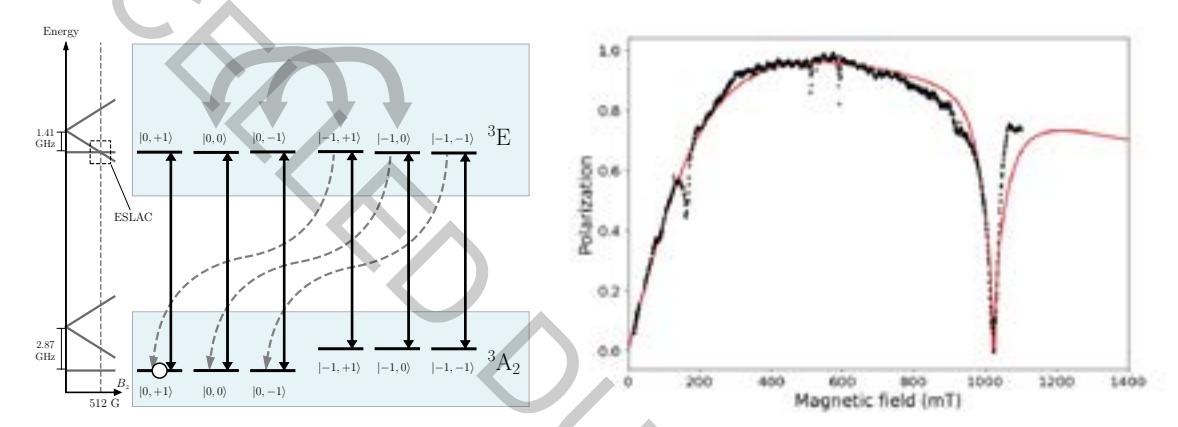
Experimentally the nuclear spin polarization of 14N was determined by fitting optically detectable magnetic resonance (ODMR) signals with multiple resonance curve [1]. The theoretical model was based on Lindblad equation for density matrix $\rho$:
$$\frac{\partial \rho}{\partial t} = -\frac{i}{\hbar} \left[ \hat{H}, \rho \right] + \hat{L}\rho = 0,\tag{1}$$where $\hat{H}$ is system Hamiltonian and $\hat{L}$ is Lindblad superoperator which is used to describe depopulation and decoherence processes of the NV center electron spin and 14N nuclear spin.
We observed that 14N nuclear spin polarization around ground state level anti-crossing (GSLAC) at 1025 G is very sensitive to magnetic field angle, even an angle as small as $\theta = 0.05^{\circ}$ destroyed nuclear spin polarization at GSLAC. However the ODMR signals at GSLAC could be used to precisely determine the angle between magnetic field and NV axis.
The experimental and theoretical polarization match very well for a wide range of magnetic field (Figure 1 right), verifying that both fitting procedure and theoretical model describe nuclear spin polarization accurately.