In this work, thermal properties of Li2FeSiO4 were studied. Lithium-iron silicate offers a promising opportunity for batteries due to its high theoretical capacity of 331 mAh g-1. Voltage of cell consisting Li2FeSiO4 as a cathode is expected to be as high as 4.0–4.8 V vs Li+/Li. Low cost and high abundance of substrates are also the advantages of this material. On the other hand, a disadvantage of Li2FeSiO4 is extremely low electronic conductivity of $6\cdot10^{-14}$ S·cm-1 [1]. Such low value may worse its electrochemical properties. Sol-gel method enables to obtain a material of high porosity and so that the both ionic and electronic conductivity may be higher [2].
In our case, the source of silicon was TEOS (SiC8H20O4). TEOS was dissolved in distilled water and ethanol solution. Water solutions of lithium and iron sources (CH3COOLi and Fe(NO3)3·9H2O) were added dropwise. Final solution was mixed on magnetic stirrer and temperature was rised up to 80–90°C in order to evaporate the excess of water. The pH of solution was controlled by adding 2M solution of ammonia. After gelation, the obtained gel was dryed in vacuum dryer. Dense, orange-colored gels were obtained.
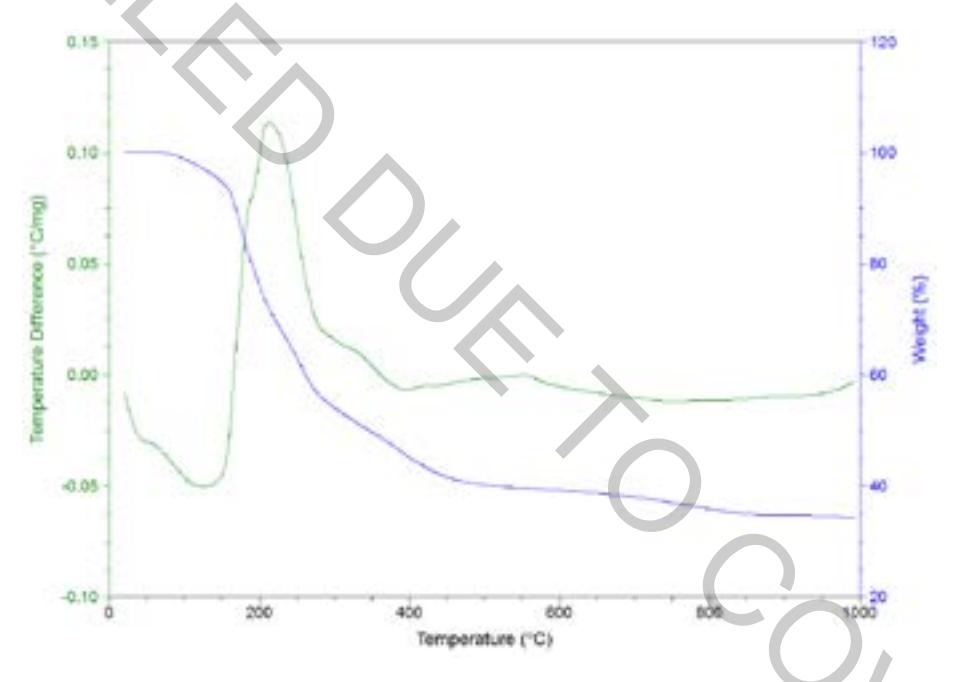
Thermal properties of gels were investigated using TA Q600 thermal analyser up to 1000°C in argon atmosphere. Typical DTA/TGA curve is presented in Fig. 1. Up to 400°C, 60% of the sample mass evaporated. The evaporated gases consisted of H2O, nitride groups and CO2. The calcination of material took part at ca. 600°C.