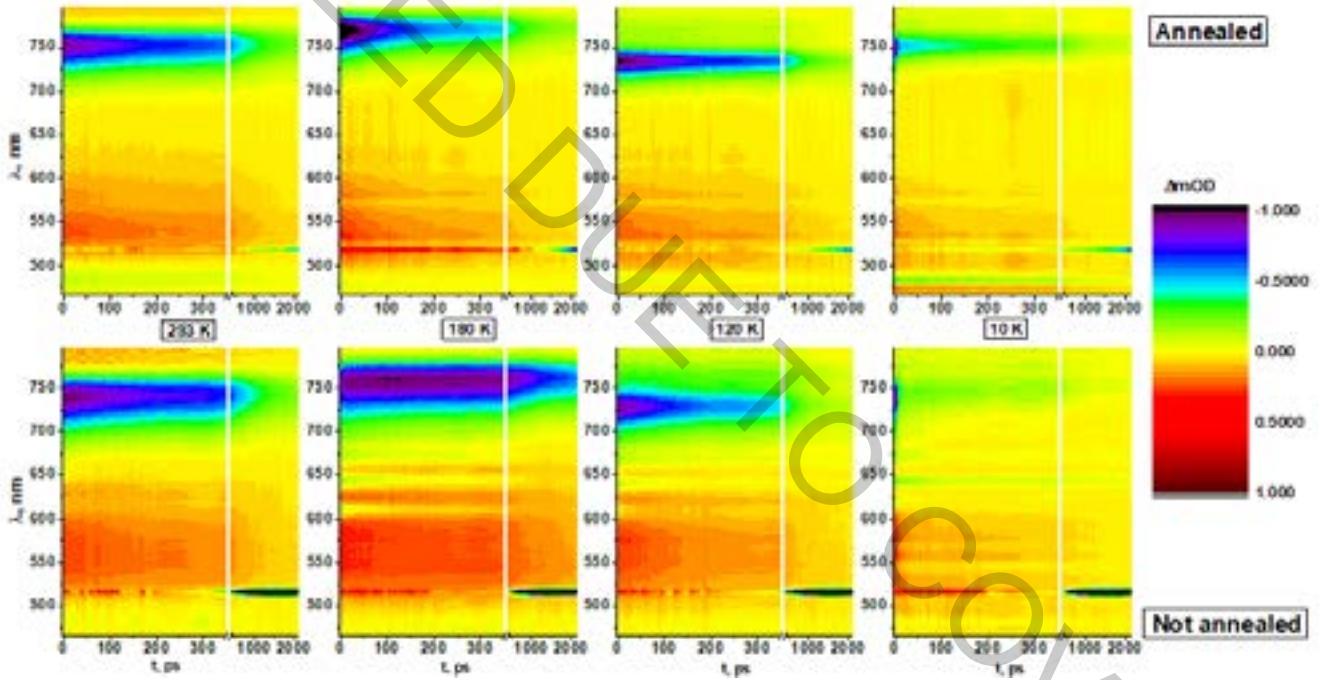
Organic – inorganic hybrid perovskites have emerged as low cost semiconducting materials with promising optoelectronic properties which can be used to create photovoltaic cells, perovskite light-emitting diodes (PeLEDs) and lasers [1]. It was observed that external quantum efficiency of electroluminescence of PeLEDs based on CH3NH3PbI3 (MAPbI3) perovskite with addition of 4-fluorobenzylammonium iodide (FPMAI) changes upon annealing. As photovoltaic cells and lasers can reach high temperatures it is important to understand exactly what effect does annealing have.
In order to elucidate the factors that play a role in appearing differences between two MAPbI3/FPMAI samples, one of which was annealed, the pump – probe optical spectroscopy was used. When various pump impulse intensities were applied in pump – probe experiment, no significant differences between samples were observed. Although, when pump impulse intensity was a constant and temperature of samples was varied in 293 K – 10K range, a major difference in charge carrier recombination time was noticed according to the dynamics of ground state bleaching detected at the wavelength of 750 nm. Moreover, not annealed sample had extra regions of absorption at wavelength interval of 600 – 650 nm. These differences might occur because sample with no annealing is made of heterogeneous crystallites. There are small regions inside crystallite with different energies. When perovskite is annealed, these regions are eliminated and crystallites become homogeneous.