
Optical components are the main parts in laser systems and used for controlling the properties of the beam. Present innovative optical devices feature integrated laser systems capable of high power and precision. Applications are in a variety of areas such as material processing (cutting, drilling), medicine, communications technology, etc. In order to apply laser systems in everyday life more, the system dimensions should be reduced by replacing existing optical components with more compact elements. In solid state laser system, isotropic crystal generates unpolarized light beam, thus additional polarizer must be placed. Therefore, unique solutions are required for optical components, such as polarizers.
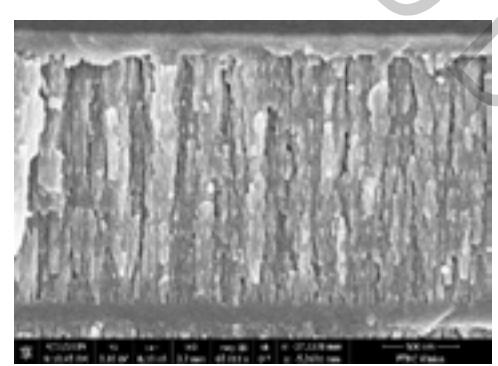
Anisotropic sculptured multilayer coating deposition directly on existing elements in the microlaser system (mirrors, nonlinear crystals, etc.) could be used to select the polarization of laser light flux. Forming such multilayer structure allows generation of desired polarization, while depolarization beam is sent from the resonator. Unfortunately, standard isotropic multilayer coatings do not have birefringence and can separate the polarized light only at large angles (e.g. Brewster angle). Columnar structure in dielectric coating (Fig. 1) induces birefringence and spectral performance of the total coating is different for perpendicular polarizations as a consequence [1].
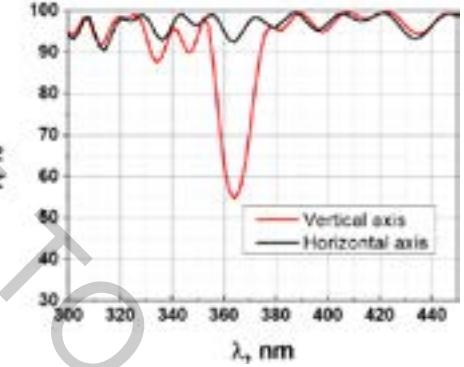
In present work, glancing angle deposition method is used to induce the self-shadowing effect [2] and form nano-structured multilayer anisotropic coatings [3]. Using physical vapor deposition method and changing the angle of a substrate, different refractive index of anisotropic layers may be achieved. Combining the layers which have similar refractive indexes in one direction (horizontal axis) and different in other direction (vertical axis), high transmission can be achieved for one polarization while Bragg mirror can be formed for the perpendicular polarization (Fig. 2).
Investigation of optical and structural properties indicates the possibility to form the all-silica polarizers for zero angle of incidence. Such optical elements exhibit superior optical performance: high resistivity to laser radiation, low optical losses and can be coated on crystal substrates.