The aircrafts are facing many problems during the flight due to harsh conditions at flying zone and these condition leads to create damages in aircraft components. However, NDT methods are purely determining the off-line investigations to identify the defects using complex and heavy equipment. Especially, these methods lead to time-consuming and vast labor involvement to test the large-scale structures. The conventional NDT methods need to disassemble the structures for testing which greatly increase the maintenance cost.
Structural health monitoring (SHM), the technology come out into limelight with the combination of advanced sensor technology to investigate the sample to reveal the damages [1,2]. The demand of SHM technology increasing day by day due to potential advantage of the reducing maintenance and lifecycle cost and increase of reliability and safety.
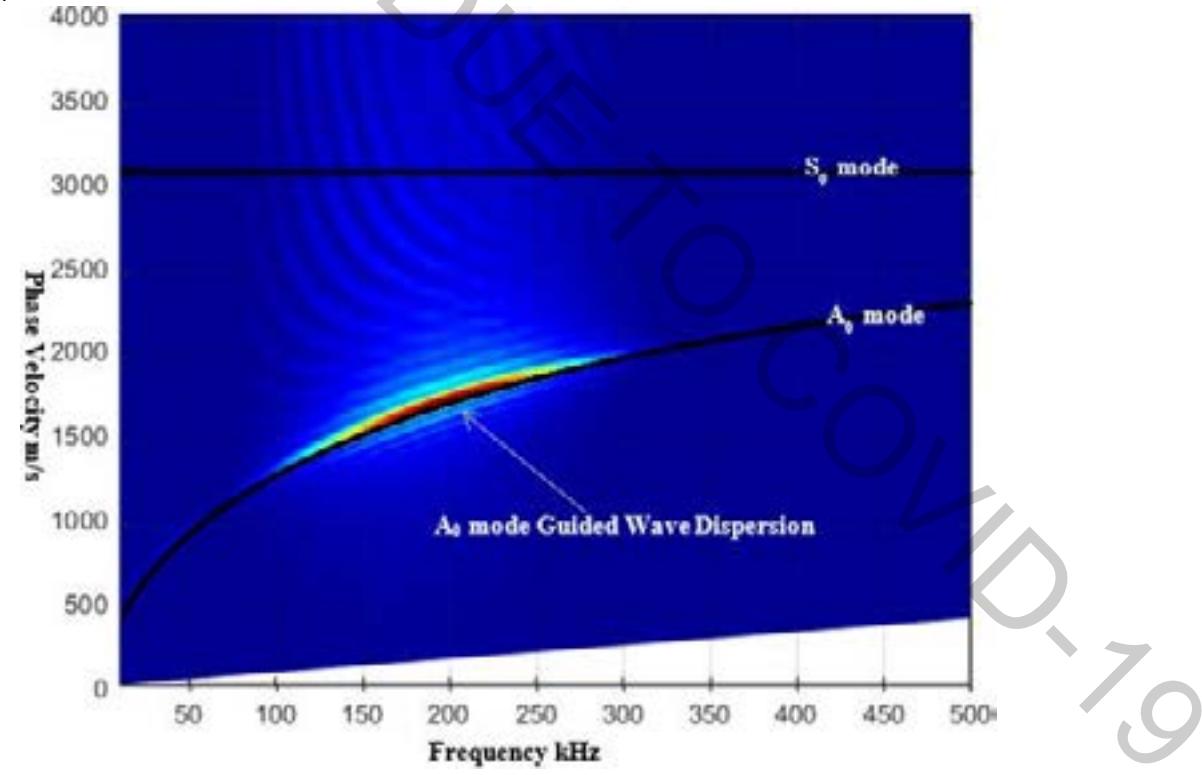
The concept initiated to give the standard damage detection scale on aluminum material. The elastic guided wave propagation and interaction on aluminum plate was modeled using Abaqus dynamic explicit solver. The simulation performed using finite element method and semi-analytical finite element technique to obtain three different modes A0, S0 and SH. The ultrasonic guided wave propagates with 200 kHz frequency and the phase velocity of A0 mode lamb wave is 1550 m/s. When there is no flaw on the plate A0 mode lamb wave propagates without distortion and dispersion curve of the of the A0 mode lamb wave overlap with scanned signal. The B-scan data obtained using 2D Fast Fourier Transformation technique and the standard dispersion curves of A0, S0 mode obtained using semi-analytical finite element method. In case of the defect in the plate at wave propagation path, the reflection, transmission and mode conversion of ultrasound wave can occur. Different type of defects can cause different type of distortion of the ultrasonic guided wave.