Hydrogen bonding is one of the most important intermolecular interactions in chemical and biological systems playing a vital role in their structure, function and dynamics. Long-range proton transport is directly related to the structure and dynamics of hydrogen bonds and the way they arrange themselves into extended networks. Pure phosphoric acid (H3PO4) is the best intrinsic proton conductor known to science, having a high density of highly mobile charge carriers. The phosphoric acid and water mixtures represent a special case in the field of proton conducting materials: at low acid concentrations the system behaves like a typical dilute aqueous solution – proton conductivity is caused by excess $H^+$ aqueous diffusion, but in concentrated solutions with higher acid contents, the conduction is increasingly determined by proton structural diffusion [1].
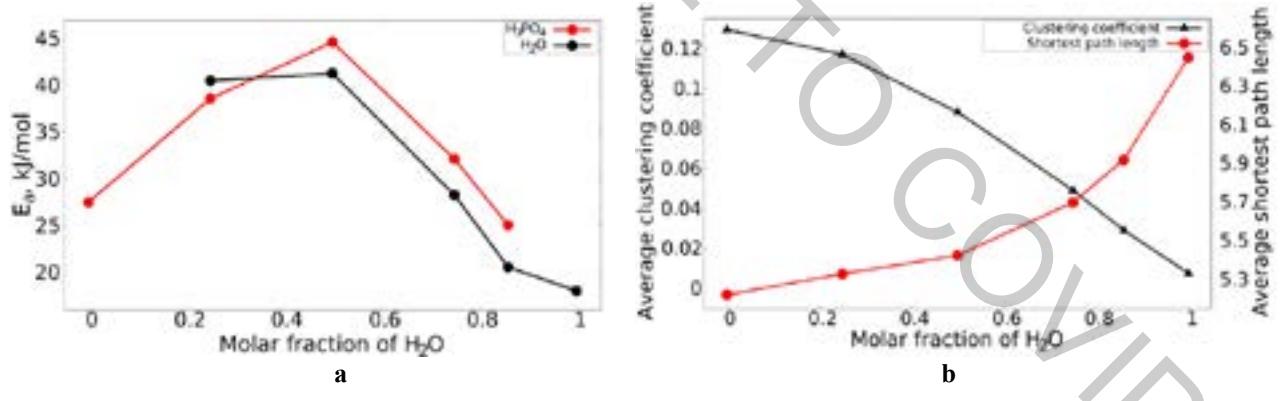
We present a theoretical study of H3PO4-H2O systems, which shows a connection between structural and dynamical properties and hydrogen bond (HB) network topology. Wide range of phosphoric acid-water systems were simulated using GROMACS molecular dynamics (MD) package, using Generalized Amber Force Field (GAFF) for phosphoric acid and flexible SPC/E model for water. From MD simulation data diffusivities, diffusion activation energies, radial distribution function (RDF) and free Helmholtz energy surfaces from combined radial-angular distribution functions (CDF) were calculated. Diffusivities for both phosphoric acid and water show a non-linear tendency to increase in systems with larger molar fraction of water in agreement with experimental data [2]. HB was defined as a contour passing through the saddle point and surrounding the local minima on the Helmholtz free energy surface calculated from the CDFs as defined by Kumar et al. [3]. Then each molecule was represented as a node and a hydrogen bond between them as an undirected, unweighted edge in a graph [4]. A number of network properties such as average shortest path length and average clustering coefficient were calculated for this HB network using Python NetworkX package. These network theoretical properties show similar tendencies to the macroscopic ones: clustering coefficient of a system decreases and shortest path length increases non-linearly, when the molar fraction of H2O increases. Therefore, these results show that there is relation between structural and dynamical properties in H3PO4-H2O systems and hydrogen bond network topology. There is a strong indication that phosphoric acid tends to form very tight HB networks having the small-world property (high clustering coefficient and low average shortest path length), whereas water is forming the usual random network (low clustering coefficient). These observations might hold key in explaining proton transport mechanism in many condensed matter systems.