
We examined the influence of the Hyades star cluster on the possibility of the appearance of long-period comets in the Solar system. It is known that the Hyades cluster is extended along the spatial orbit on tens of parsecs. To our estimations, 0.85 million years ago, there was a close approach of the cluster to the Sun of 24.8 pc. The approach of one of the cluster stars to the Sun at the minimally known distance of about 6.9 pc was 1.6 million years ago according to catalogue presented in [1] and 2.1 pc 1.5 million years ago according to [2]. The main part of the cluster was close to the Sun from 1 to 2 million years ago (all simulations performed using [3]). Such proximity is not essential for the impact on the dynamics of small bodies in the external part of the Oort cloud, although the view may change after additional study of the cluster structure. Possible orbits perihelion displacements of the small bodies of the outer part of the Oort cloud move some of them in observable comets region.
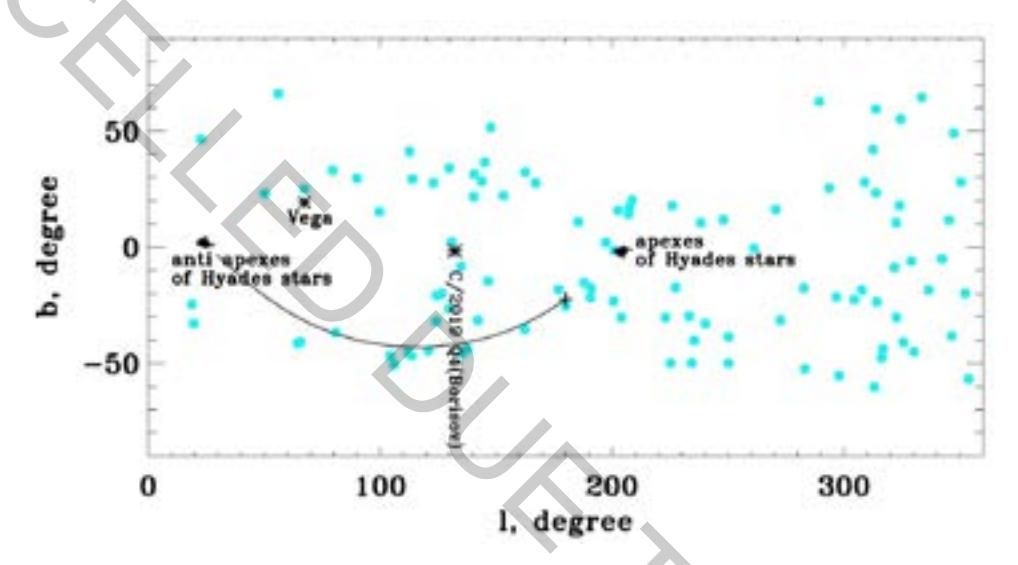
Could such a rapprochement between the Sun and Hyades cluster affect the orbit parameter change of many small bodies from the Oort cloud? Only under certain conditions. Analytical estimations gives us cluster perturbation velocity $\Delta V = 0.01m \cdot s^{-1}$, using equation 1, where $M_{Hyades} = 435M\odot$ [5] considering 1.15 mass increment [6] because of 20% unresolved binaries, $r_{comet} = 0.5$pc for Outer Oort cloud comets and $V, d_{close\ approach}$ is a Hyades cluster velocity and close approach distance.
$$\Delta V = \frac{2 \cdot G \cdot M_{Hyades} \cdot r_{comet}}{V \cdot d_{close\ approach}^2} \tag{1}$$Note that perihelion perturbation can be $\Delta q = 1$ AU (while Galactic tidal gives 10 AU), and Hyades passed "under” the Solar system in the galactic disk, which increasing perturbations, so one should note such influences.