
According to the Intergovernmental Panel on Climate Change (IPCC), the global mean temperature is likely to increase by 1.8-4.8 °C by 2100 [1]. Rising global temperature will have an impact on water bodies, such as oceans, lakes, etc. As a result, higher temperatures could cause an increase of eutrophication in lakes and induce major changes in the ecosystem of a water body.
During the period 1983-2004, Lake Druksiai was used as the source of cooling water for the Ignalina Nuclear Power Plant (INPP). This raised the average monthly surface temperature of the lake by 3-4 °C [2].
The aim of this research was to analyze the variations of stable carbon isotope concentrations in the Lake Druksiai due to anthropogenic influence. The lake sediment and vendace (C. albula) scale samples were collected from the Druksiai lake. This species of pelagic fish was chosen because it was proved by earlier investigations that the planktivorous vendace feeds exclusively on zooplankton and a relatively short food chain (dissolved inorganic carbon (DIC) $ \rightarrow $ phytoplankton $ \rightarrow $ zooplankton $ \rightarrow $ vendace) is expected. Thus, fish scales reflect averaged $ \delta^{13}C $ values of 2 years in DIC of the lake water. ABA (acid-base-acid) chemical pretreatment procedure was used to extract humin (HM) and humic acid (HA) fractions from the sediments. $ \delta^{13}C $ measurements in the lake sediment organic fractions and vendace scale samples were performed using the Thermo Flash EA 1112 elemental analyzer connected to the Thermo Scientific Delta V Advantage isotope ratio mass spectrometer.
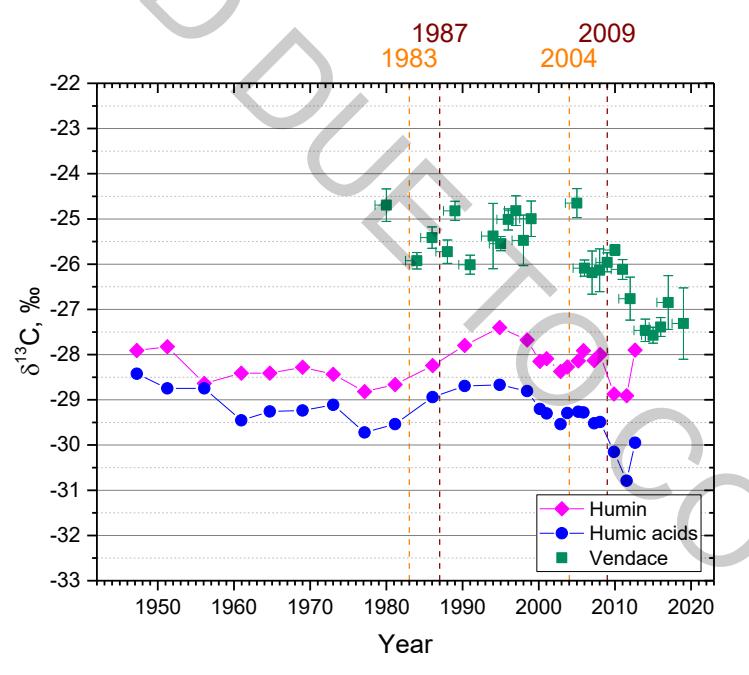
$ \delta^{13}C $ measurements in humin and humic acid fractions (Fig. 1) have shown that eutrophication of the lake caused an increase in $ \delta^{13}C $ values of the lake sediments (1983-1995). In 1995, there was a change in predominant aquatic plants (shift from phytoplankton to submerged macrophytes) of the Lake Druksiai which caused $ \delta^{13}C $ in sediments to decrease. Since 2005, stable carbon isotope concentration in both sediments and fish samples follow the same trend: during 2005-2009, $ \delta^{13}C $ values are constant and after the shutdown of the INPP in 2009 the $ \delta^{13}C $ values are decreasing. The reduction of thermal and chemical pollution significantly reduced the impact of these local effects on the ecosystem of Lake Druksiai.