
To this day, despite all technological achievements, color changing clothes are still found to be futuristic. Controlled color change clothing could be entitled as a product of a smart textile - fabrics that have been developed with new technologies to provide additional functionality and value. Light emitting elements are often used in a formation of color adjustable wearable devices [1]. However, this method suffers from some major drawbacks: high cost, color dependency on the environment lighting and continuous electrical consumption. Chromic materials can also be employed in the development of smart fabrics [2]. Because of their low power consumption, good stability and high color contrast exploration of electrochromic materials is a promising way to create a color changing textile-based devices [3]. In this study conducting polymer polyaniline was deposited on the metal-plated textile surface and the electrochromic properties of the obtained composite investigated.
Aniline was polymerized electrochemically on polyester fabric, plated with copper-nickel, which was used as working electrode. Deposition was carried from a $0.2\,M$ aniline solution in $0.5\,M$ H2SO4 (Fig. 1). The obtained composite structures were further investigated by recording electrochemical potential-induced color change with smartphone video camera and analyzing captured material with digital image analysis software ImageJ (National institution of health (USA)). All colors can be expressed as numeric value from 0 to 255 (mean gray value - MGV), thus the difference between two electrochromic states can be expressed as a mathematical subtraction of those states numeric values ($\Delta$MGV).
By manipulating the values and the duration of the potential applied, optimal working conditions for polyaniline/textile composites were achieved. Potential switching values for maximum optical contrast between reduced and oxidized states were obtained. However, by lowering determined anodic potential, significant increase in electrochromic stability can be obtained by losing negligible part of optical contrast. It was also observed that the stability of electrochromic composite can be further improved by applying reduction potential for longer times than anodic potential.
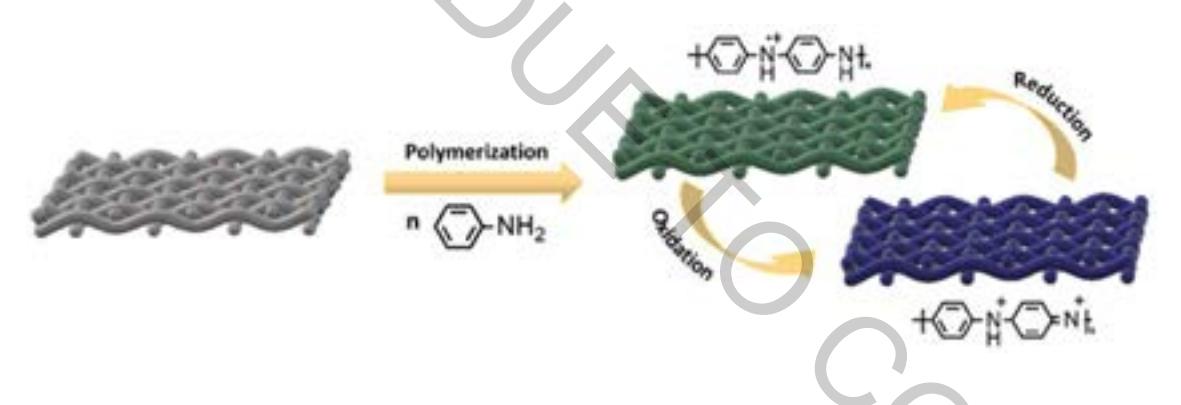
Polyaniline/textile composites demonstrated reversible electrochromic color change. By manipulating the applied electrochemical potential, optimal operating conditions for maximum stability and lifetime of composite were achieved. Combining electrochromic materials with metal plated textiles is a promising way to produce color changing textiles that can lead to a further development of a smart wearable displays.