
Terahertz (THz) frequency range radiation has various applications such as security, medical diagnosis, high speed communication, etc. Due to the fact that THz radiation is non-ionizing, the imaging and spectroscopy in THz spectral range are promising techniques for non-destructive inspection [1]. For the development of room temperature operating THz technology the compact and efficient THz emitters are crucial elements. One of the methods to meet requirements for THz generation is emission from parabolic quantum wells (PQWs) through intersubband carrier transition. In this work, the investigation of emission from Ga(As,Bi)/AlGaAs nanostrutures with PQWs is presented.
GaAsBi/GaAs rectangular quantum wells (QW) in GaAs/AlGaAs PQWs were grown using molecular beam epitaxy [2]. The active region consists of 52 nm width undoped PQW designed for equidistant energy subbands structure to meet the energy difference between subbands of 29 meV (7 THz). At the center of single GaAs/AlGaAs PQW single 7 nm wide GaAsBi rectangular QW is introduced to enable faster carrier depopulation form the PQW subbands [3]. The active region is sandwiched between undoped Al0.3Ga0.7As layers and then between doped Al0.3Ga0.7As layers with n-type from bottom side and p-type from top side. Doped structures were grown on the n+-type GaAs substrate. Then metal ohmic contacts were deposited. For optical characterization undoped samples were also prepared.
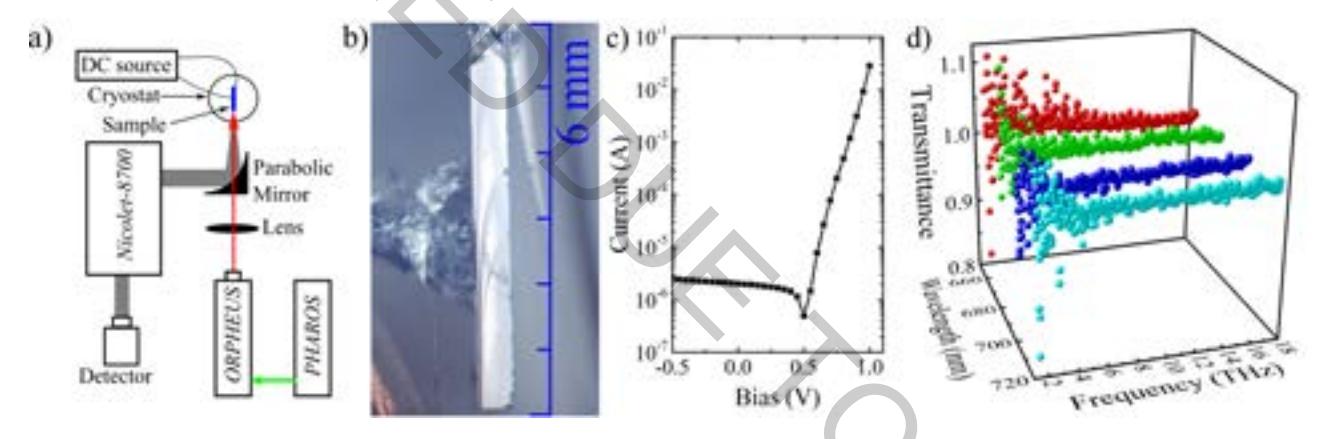
Prior to THz emission experiment the low temperature photoluminescence (PL) spectroscopy was carried out for the undoped samples. The 4th harmonic of the solid state laser with 4.66 eV photon energy, 0.5 m focal length monochromator and thermo-electrically cooled photo-multiplier tube were used in PL set-up. Measurements of THz transmission spectroscopy carried out with Nicolet-8700 (Thermo Scientific) far infrared Fourier transform spectrometer. For emission measurements samples were set as the external source of THz radiation for spectrometer (Fig. 1a). For excitation PHAROS femtosecond laser with ORPHEUS collinear optical parametric amplifier (Light conversion) was used. Excitation power density was kept at 3.5 W/cm2. Samples have electrical wires (Fig. 1b) in order to apply external DC bias and were put in the cryostat which was cooled down to 80 K.
PL spectra revealed that the structure of energy subbands in the PQW is nearly to the designed one. From transmission spectroscopy measurements spectral features were observed at 4.69 THz and 7.1 THz [4]. Measured I-V characteristics of doped samples show asymmetrical pn junction behaviour (Fig.1c). Fig.1d shows the measured emission spectra for one of samples with 300 mV applied bias and at different excitation wavelengths. With current experimental set-up the THz torch device emission was below detection limit. However, the new approach of the measurement using 45° angle polished device geometry is very likely to allow to prove the working principle of the THz torch by measuring emission signal.