
As the consequences of climate change are becoming more visible and difficult to manage, the importance of understanding the influence of composition and aging processes of atmospheric aerosols on climate and air quality is crucial. The impact of aerosol particles on climate and ecosystems comes from the ability to scatter or absorb solar radiation and alter optical properties of clouds. The interaction of light and the particle is strongly dependent on the chemical composition of aerosol particles. One of the most abundant light-absorbing components of atmospheric aerosols emerging from fossil fuel combustion and biomass burning in urban areas is black carbon (BC) which is strongly associated with air pollution and climate change. Its significance as a short-lived climate forcer was acknowledged in special report Global Warming of 1.5 °C by IPCC [1]. And yet, the net impact of BC is still unknown as it can influence climate through multiple mechanisms [2]. While the importance of BC light absorption to atmospheric radiative balance is widely known, the input of colored organic aerosol (OA) (known as light absorbing brown carbon (BrC)) is often downgraded. In fact, recent studies demonstrated that BrC accounts for 20-40% of the total absorption by carbonaceous aerosols and causes radiative effects of +0.1 to +0.6 W/m2 in global scale [3].
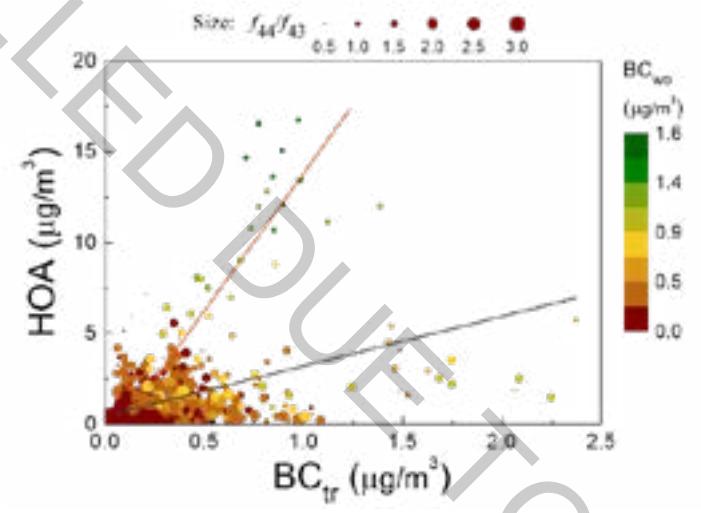
An Aerosol Chemical Speciation Monitor (ACSM) and a 7-wavelength Aethalometer were deployed in Vilnius (urban background site) in October 2014 – April 2015. The aim of this study is to perform a systematic source apportionment for OA and BC by examining dynamics of mass concentration and optical properties as well as BrC absorption coefficient alteration during heating and non-heating seasons. In order to separate BCtr (originated from traffic emissions) and BCwb (originated from biomass burning) the most suitable values of AAE (absorption Angstrom exponent) were selected (0.9 and 2.09), respectively. It has been found that during heating season contribution of BCwb to total BC was 55%. OA source apportionment analysis (PMF) revealed four main sources: hydrocarbon-like OA (HOA), local OA (LOA), biomass burning OA (BBOA) and oxygenated OA (OOA). Diurnal analysis showed that HOA mass concentration variation corresponds well with the traffic rush hours. However, low correlation was found between HOA and BCtr mass concentrations, indicating that HOA could originate not only from fossil fuel combustion (Figure 1). The results of this study will provide additional insights into forecasting the radiative forcing in local and global scale.