In recent years, the up-converting nanoparticles (UCNPs) have a tremendous scientific interest. Due to combined properties such as magnetic, optical stability, low toxicity, these particles have application possibilities in multiple fields: drug delivery, bio-sensing, nanophotonics, nanoelectronics and many more. However, the versatile applicability of particles usually is limited by poor colloidal stability, especially in aqueous media. The preparation of stable nanoparticle dispersion is one of the major challenge restricting wide and easy usage in research and modern technology. Several approaches including surface ligand exchange, ligand removal, ligand oxidation, silanization, and amphiphilic polymer [1] coating have been developed in order to transfer stable nanoparticles into aqueous biological medium, however the universal method to obtain stable coloids is not found yet. Taking into account all applied materials in colloidal stabilization, the non-linear structure (brush-type) polyelectrolytes have highest potential to be developed as super dispersants for UPNPs, because of the ability to modify surfaces creating steric barriers, preventing particles to form agglomerates.
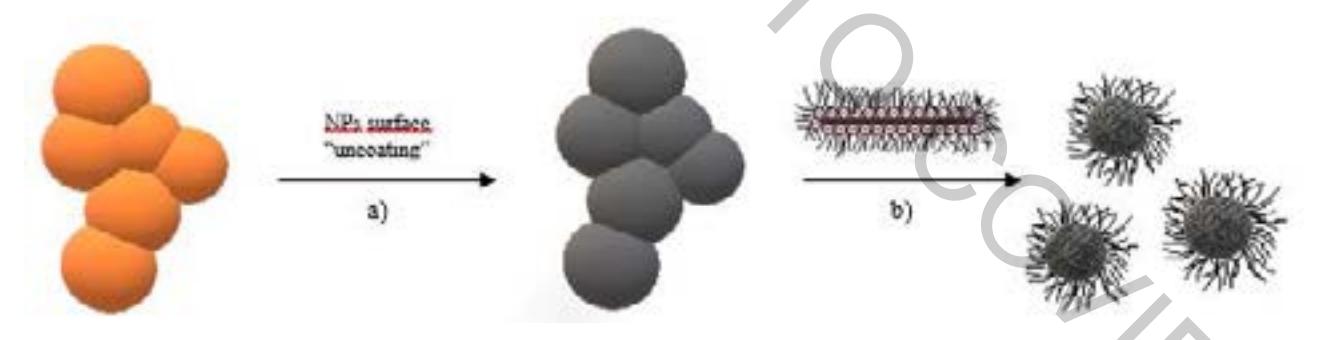
In this work the focus was on study of core NaGdF4:Yb3+/Er3+ up-converting nanoparticles synthesis and demonstration of effective surface modification method for stabilization using anionic brush-type p(MAA-stat-PEO9MEMA) polyelectrolytes. The $\beta$-NaGdF4:Yb3+/Er3+ nanoparticles with distinct diameter of around 12 nm were synthesized via thermal decomposition method, following published procedure with minor adjustments [2]. The exact diameter and crystal structure of synthesized core particles were determined using scanning electron microscopy (SEM) and powder X-ray diffraction (XRD). The surface modification procedure was carried out in two steps: 1) the oleic acid ligands were removed from the surface of NPs; 2) the anionic brush-type p(MAA-stat-PEO9MEMA) were applied onto "uncoated" NPs.
The colloidal stability of "uncoated" particles and particles modified with anionic brush-type polyelectrolytes were initially studied and compared. First, the isoelectric point of "uncoated" NaGdF4:Yb3+/Er3+ nanoparticles in aqueous dispersion were determined by measuring zeta potentials under various pH. The particles size distribution (PSD) in colloidal systems at each pH were determined by dynamic light scattering (DLS). The pH value, where surface charge of NaGdF4:Yb3+/Er3+ particles is positively expressed was chosen, and the effect of polyeletrolyte concentration on particle surface potential change and colloidal stability was evaluated. The stability of both "uncoated" and modified particles under biological pH range (pH = 7.4) was evaluated and compared.