Laser technology provides new and revolutionizing solutions to many different fields ranging from agriculture [1] to military [2] and space industries [3]. Annual increase in the photon-based solutions provides us with highly precise tools that do not require contact to obtain information or perform certain tasks. Currently, mostly high-power continuous wave or long pulse (millisecond-nanosecond) laser systems are used in the industry. Nevertheless, in order to achieve nano-level precision ultrashort picosecond (ps) and femtosecond (fs) laser pulses are needed. They allow initiation of vast array of highly localized nonlinear light-matter interactions which became the basis for variety of novel laser material processing techniques [4].
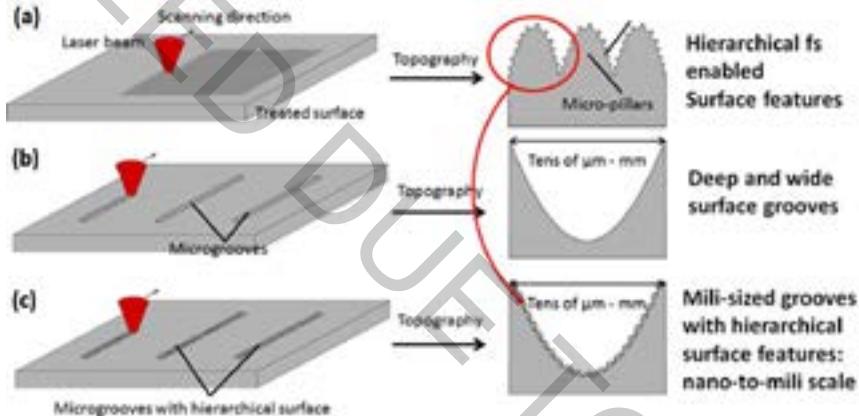
One of the areas that highly benefited from these developments was ultra-precise surface patterning. It allows to produce hierarchical surface patterns with feature sizes ranging from hundreds of nm to tens of μm [Fig. 1]. Such surface topographies allow to control multitude of surface parameters allowing it to become hydrophobic, hydrophilic, repulsive or highly adhering. In addition, change between these surface properties are easily induced by changing exposure parameters during the fabrication process. For this reason, complete understanding of how laser parameters influence relevant surface properties is extremely important.
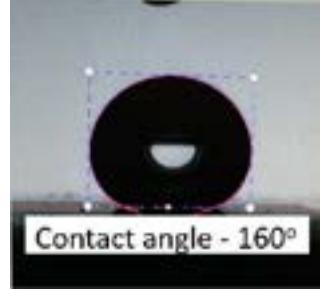
In this work we investigated how fabrication parameters such as wavelength, pulse duration, repetition rate, pulse energy, overlap and spot size influence the wetting properties of various metal sample. The chosen metal samples represent alloys most prominent in industries like medicine, maritime and aviation. SEM analysis as well as contact angle measurements and profilometer readings were used for qualitative surface analysis. At the same time their wetting properties were tested, showing contact angles in the range of 5 to 170 degrees [Fig. 2]. These results are presented in the context of current state-of-the-art highlighting possibilities and challenges in further developing this technology.