
Diamond-like carbon (DLC) is amorphous type of carbon, in which most of the bonds between carbon atoms are sp3 type. DLC is distinguished by its mechanical hardness, chemical inertness and optical transparency [1]. Because of these properties, DLC thin films are widely used in industry, micro-electromechanics and biomedicine. It has been observed, that DLC with embedded silver nanoparticles (DLC:Ag) changes its tribological and optical properties. The optical absorption of metallic nanoparticles embedded in the dielectric matrix shows very high visible light absorption which can be used to improve the efficiency of solar cells or make conversion from light to heat or electrical energy more effective [2].
Spectroscopic ellipsometry (SE) is an optical measurement which is used to determine the change in polarization of incident linearly polarized light upon the reflection on the sample. In this way, two parameters are measured: amplitude ratio $\Psi$ and phase difference $\Delta$ between s and p polarized waves. It is possible to calculate the refraction index and extinction coefficient of the thin film using these parameters [3].
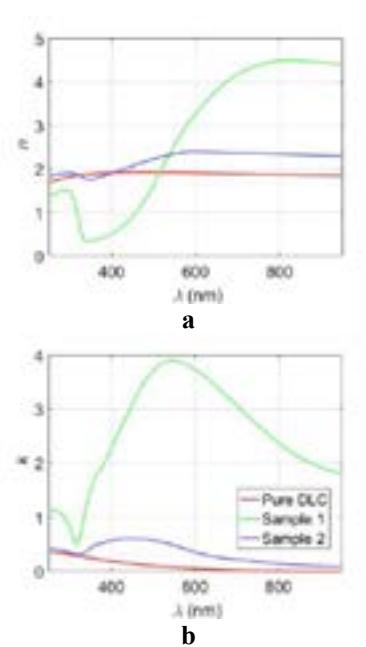
In this work, 2 samples of DLC:Ag with different silver atomic concentration of 14.1% (Sample 1) and 7.9% (Sample 2) were investigated employing SE. The obtained dispersion curves are shown in Fig. 1. Then these dispersion curves were used by rigorous-coupled wave analysis (RCWA) method to model the absorption of light (measured in arbitrary units) at wavelength range from 250 to 950 nm and varying the thickness of the film d from 10 to 200 nm at s and p polarization at a 45° angle of incidence. The results are shown in the Fig. 2
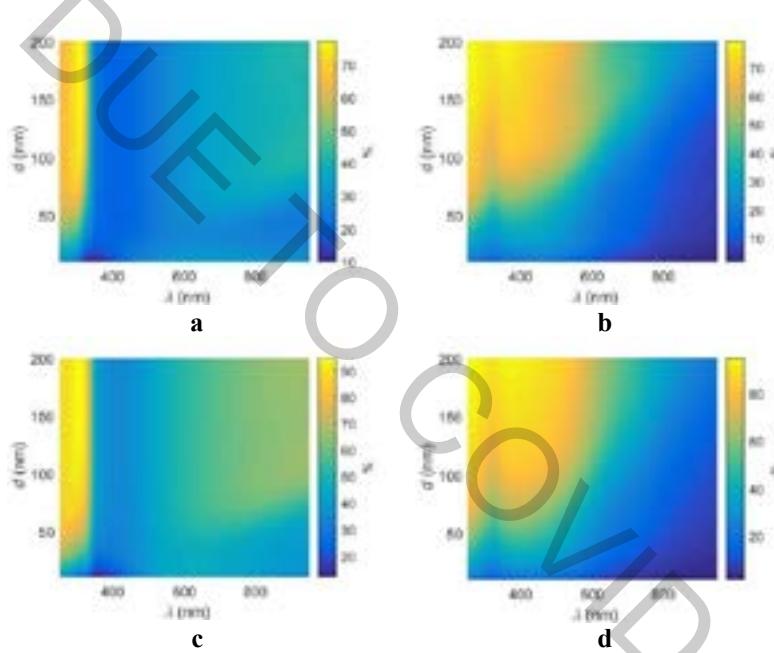
From the modelled results it is clear that at 45° angle of incidence, Sample 2 has higher light absorption in the wavelength range from 250 to 450 nm compared to Sample 1. Since the Solar cells and optical sensors have to absorb the light at wide range of angles of incidence to be efficient, the further analysis would lead to optical absorption modelling at different angles of incidence.