In recent years, perovskite methylammonium lead halides CH3NH3PbX3 ( where X = I, Br, Cl) have gained notable attention of the scientific community as they show properties appropriate in the making of efficient and affordable solar cells. The key factor for this valuable use is the power conversion efficiency (PCE) which was recently improved to exceed 20% [1]. For this particular reason perovskite solar cells based on MAPBI3 are challenging existing silicon-based solar cell technology with their simple solution process and low costs. In this research MAPBI3 crystals were studied along different crystallographic directions in 150-300 K temperature range and 100Hz – 1 MHz frequency region.
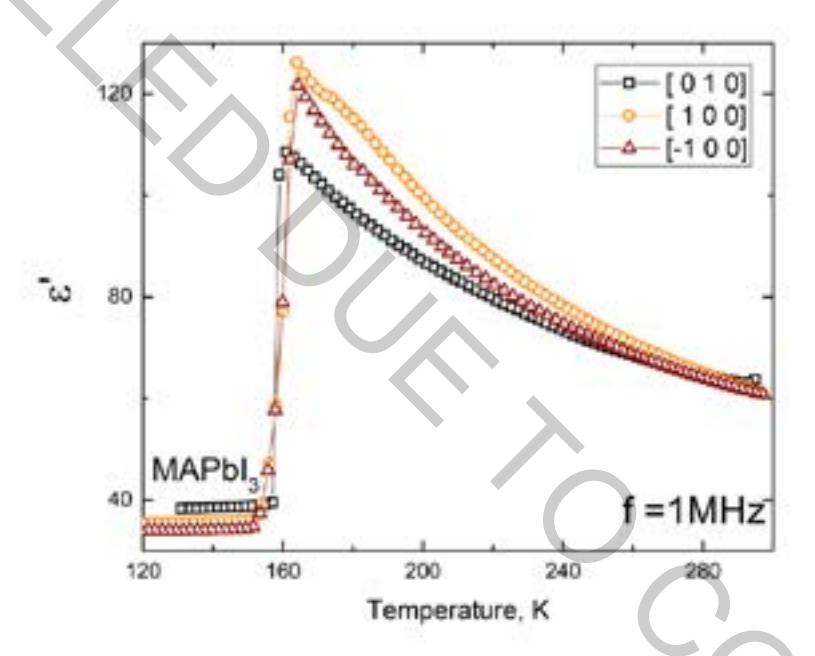
Figure 1 shows the temperature dependences of the dielectric permittivity measured upon cooling at 1 MHz. The real part of dielectric permittivity experiences a gradual increase and in 162 K step- like anomaly can be observed. This behavior corresponds to the tetragonal-to-orthorombic phase transition. [2].There seems to be a slight difference in dielectric properties whilst measuring in one particular direction.