
In large and complex stellar populations such as galaxies it is difficult to predict the number of black holes and parameters of black hole (BH) population. Even more so for binary black hole systems, as the population of these systems is highly influenced by violent binary interactions during their evolution. Different initial parameters, such as metallicity or IMF also influence the binary black hole population. Natal kicks and binary mergers greatly reduce the number of black holes remaining in binaries. however according to a recent population synthesis study there should be around 3 million black holes remaining in binaries in the Milky Way. Based on OGLE-IV survey results that capture 2000 new gravitational microlensing events each year, 26 are caused by black holes. Out of those 26 events, 8 are estimated to be caused by binary black holes and in our study we found that one of these events should be resolvable as two peaks within single magnification period. We used a synthetic binary black hole population database to create gravitational microlensing events and generate theoretical light curves to check for resolvability of microlensing caused by these systems.
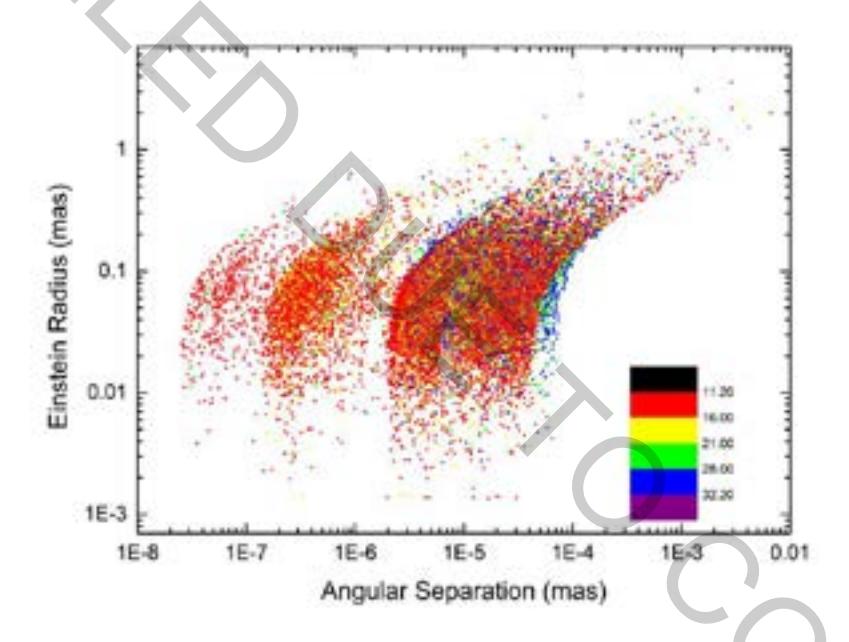
In order to simulate the microlensing events I used the database Universe@Home [1] with synthetic BBH population and used their derived parameters of these systems. I calculated Einstein radii of these events and mass lens separation ratio of these binary systems in order to create caustic maps. Our program solves general gravitational lensing equation for a binary system [2] and plots magnification maps of microlensing events with binary black holes as lens using inverse ray shooting. Based on magnification of the source, I generated theoretical light curves of the microlensing events to study the resolvability of these events. Based on my results I found that around 3% of the events are unseparable, 17% are distinct with two peaks over each component of the binary system and 80% have two different magnification periods on a single plane, resembling two different lensing events. Since OGLE-IV finds 8 microlensing events per year caused by binary black holes such event should be found once per year having single magnification period and two peaks, caused by the binarity of the system.