
new donor-acceptor compounds were designed, synthesized and investigated by theoretical and experimental approaches aiming to estimate effect of the structure of a donor on the properties of potential OLED emitters. Because of the different electron-donating abilities of the nitrogen-containing heterocycles, derivatives of xanthenone containing di-tert-butyl-carbazolyl, di-tert-butyl-acridanyl, di-tert-butyl-phenothiazinyl and penoxazinyl moieties exhibited different photophysical behavior. Because of big dihedral angles between the donors and acceptor as well as because of possibility of rotation around N-C bond, the designed compounds were characterized by thermally activated delayed fluorescence and aggregation induced emission enhancement effect. Twice higher photoluminescence quantum yields reaching 38% in doped films were obtained for compounds containing di-tert-butyl-carbazolyl and di-tert-butyl-acridanyl moieties as compared to those observed for compounds with the donors containing S and O heteroatoms. Strong effect of the donor substituents on charge injection (ionization potentials were in the range of 5.67-5.96 eV) and charge-transporting properties (hole and electron mobilities were in a wide range from $6.3\times10^{-8}$ to $6.3\times10^{-4}$ cm2V-1s-1 at electric field of $2.5\times10^{5}$ V·cm-1) was detected. The differently substituted compounds were utilized as emitters in OLEDs. Higher maximum values of brightness (up to 20900 cdm-2) were observed for OLEDs based on emitters with nitrogen containing donors relative to estimated for OLEDs based on emitters containing di-tert-butyl-phenothiazinyl and penoxazinyl moieties. Energy diagram and EL spectra of OLEDs submitted at Figure 1.
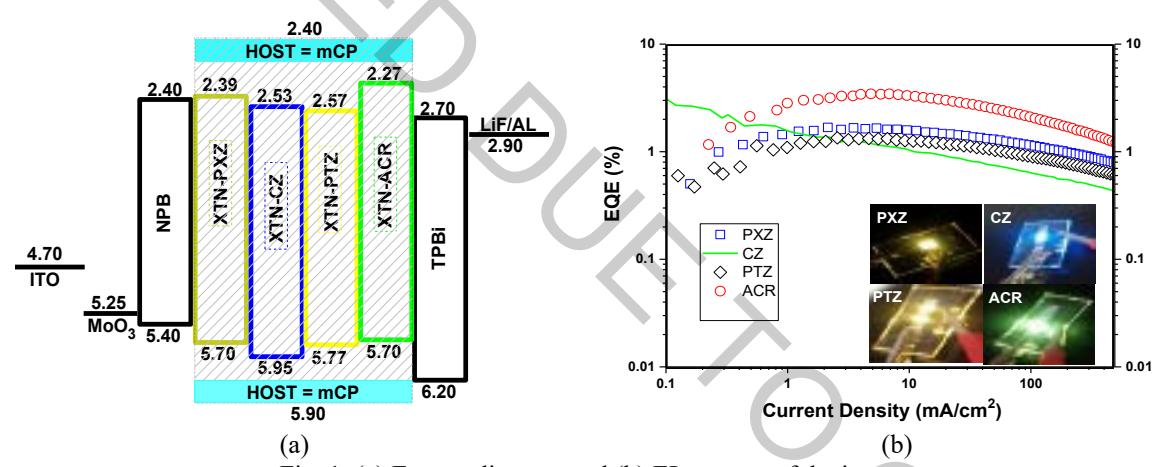
The radiation transition rates of the doped films of the compounds were calculated using the formula [1].
$$k_{PF} = \frac{\eta_{PF}}{\tau_{PF}} \tag{1}$$$$k_{ISC} = \frac{\eta_{DF}}{\eta_{PF} + \eta_{DF}} k_{PF} \tag{2}$$$$k_{DF} = \frac{\eta_{DF}}{\tau_{DF}} \tag{3}$$$$k_{RISC} = \frac{\eta_{DF}}{\eta_{PF}} \cdot \frac{k_{PF} \cdot k_{DF}}{k_{ISC}} \tag{4}$$where kPF, kDF, kISC, and kRISC are rate constants of prompt and delayed components, intersystem crossing (ISC) and RISC processes, respectively; $\eta_{PF}$ and $\eta_{DF}$ are prompt and delayed PLQYs distinguished from the total PLQY by comparing the integrated intensity of the prompt and delayed components. kISC and kRISC values of compound XTN-ACR were reported $1.15\times10^{6}$ s-1 and $0.8\times10^{5}$ s-1 respectively.