Electron-impact single and multiple ionization processes provide fundamental understanding of the electronic dynamics and structure of atoms and ions. Therefore these processes have been the focus of many theoretical and experimental studies. The study of multiple ionization processes is quite complicated as one has to deal at least with four-body Coulomb problem.
The aim of this work is to study electron-impact double ionization (DI) process of the B+ ion. Contribution of direct and indirect processes to the total double ionization process is considered. Direct double ionization (DDI) process is investigated by applying a few-step approach [1]. This method simplifies the solution of the complex four-body Coulomb problem by treating DDI process as a sequence of two- (ionization-ionization) and three-step (excitation-ionization-ionization, and ionization-excitation-ionization ) processes. This method has already been successfully applied in the study of DDI process for light ions. In addition of previously described two-step processes, in this work another two few-step processes were used to study DI of B+ ion. Those processes include ionization-excitation process followed by further autoionization process and excitation-ionization-autoionization process. Influence of the correlation effects to the formation of the B3+ ion was also considered. Two limiting cases of the energy distribution of the scattered and ejected electrons are presented: scattered and ejected electrons share the excess energy (DDI1), and one of the electrons takes all the available energy (DDI2).
Atomic data, needed for calculation of DI cross sections, have been calculated using the Flexible Atomic Code [2], which implements the Dirac-Fock-Slater approach. Electron-impact excitation and single ionization processes were investigated using the distorted-wave (DW) approximation. For electron-impact ionization and excitation processes scaling factors [3] were introduced to diminish DW cross sections, since it is well known that DW approximation often overestimates electron-impact ionization and excitation cross sections for atoms and near neutral ions.
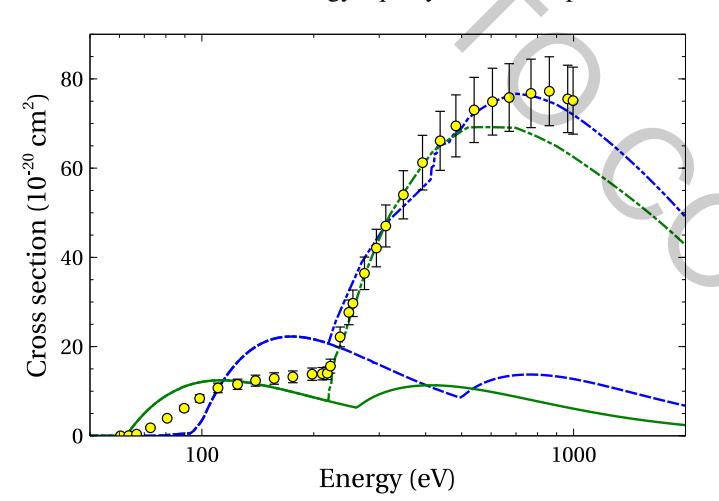
For DDI process, it has been shown (Fig. 1), that at the lower energies of the incident electron, the better agreement between theoretical cross sections and experimental ones is achieved in DDI1 case. However near the ionization threshold experimental cross sections are overestimated by theoretical ones, while at higher energies DDI1 cross sections underestimate the experimental ones. On the contrary, DDI2 cross sections underestimate experimental ones at lower energies and overestimate at higher energies. It shows that two limiting cases of energy distribution cannot correctly describe the DDI process and some intermediate energy distribution of electrons should be taken into consideration. At the energies above the ionization threshold of the inner shell of B+ ion good agreement with experiment is given by total DI cross sections when scattered and ejected electrons share the excess energy equally in the DDI process.