
Monitoring pressure, temperature and the concentration of carbon dioxide on International Space Station (ISS) is an integral part of keeping astronauts safe and preventing any possible accidents. The level of CO2 on ISS is a few times higher than normal CO2 concentration on Earth because of the limitations of technology as well as limited space. That is why even a slight increase in the concentration of carbon dioxide can result in headaches, sleepiness and tiredness of the orbital station inhabitants. Due to these reasons, constant monitoring of CO2 levels at various points of cabin is of crucial importance for successful operation of ISS and the well-being of its crew.
There are numerous reported gas sensors that can detect low levels of CO2 in comparably short amount of time, however, there are few issues that must be addressed: long term stability, effects of relative humidity (R.H.) on sensor response (SR), high power consumption, bulkiness and high cost. Infrared spectroscopy based gas sensors are commonly used in CO2 level detection, although they have several drawbacks, such as large size and high cost. This creates a demand for inexpensive, maintenance-free and easy-to-make CO2 sensors, whose development is reported in this work.
The developed sensor is based on metal/metal oxide working electrode, solid state Ag/AgCl reference electrode and gel electrolyte [1]. Gel electrolyte used in the sensor is composed of glycerol or ethylene glycol as a humectant that absorbs water from air even at low levels of R.H. This makes sensor resistant to drying out under low humidity conditions. Alongside H2O vapor, carbon dioxide is absorbed into the electrolyte as well. Carbon dioxide reacts with OH- to form a stable HCO3-, in turn lowering the pH of the electrolyte (Eq. 1). Metal/metal oxide electrodes are known for having pH-
$$H_2O + CO_2 \leftrightarrow HCO_3^- + H^+ \tag{1}$$dependent electrochemical potential, for this reason they are commonly used as working electrodes for pH sensors. The electrochemical potential of Ti/TiO2 electrode changes with respect to the pH of the media (Eq. 2), whereas the reference
$$E = E^0_{Ti,TiO_2,H^+} - 2.303 \frac{RT}{F} \text{ pH} \tag{2}$$Ag/AgCl electrode potential is independent of pH. As Cl- ions are sealed with layers of Nafion, it can be assumed that the electrochemical potential of Ag/AgCl electrode remains stable throughout the measurement. From the registered potential difference between the sensing and the reference electrodes, sensor response can be derived and calculated.
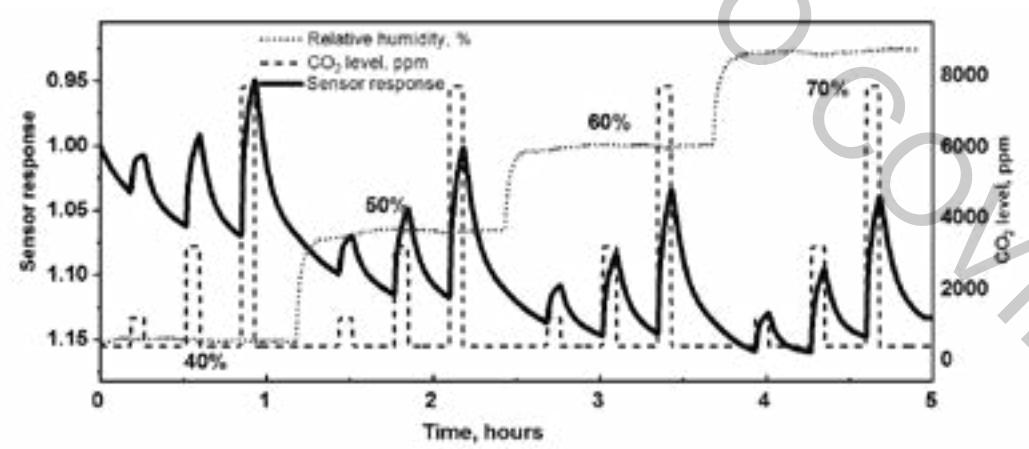
The main focus of this research was to determine the optimal composition of gel electrolyte. Different electrolytes (salts, acids, bases), humectants and concentrations of the aforementioned components were tested and formula with best sensor response was chosen to use for further research.