Ceramic materials possess a wide range of useful properties including great mechanical and chemical resistance and thermal stability. This has lead to them being extensively used in science and industry, with intensive research being done on the methods of manufacturing of ceramic structures. One option for the fabrication of ceramic micro-structures is to use direct laser writing. Direct laser writing using multi-photon polymerization is powerful method for the additive manufacturing of fully 3D micro- and nano-structures for diverse applications in microfluidic, micromechanic and electronic, biomedical, metamaterial as well as nanophotonic research fields [1]. It has been demonstrated that using direct laser writing in conjunction with calcination of the hybrid organic-inorganic polymer SZ8020 it is possible to manufacture glass-ceramic micro-structures with sub-100 nm resolution [2].
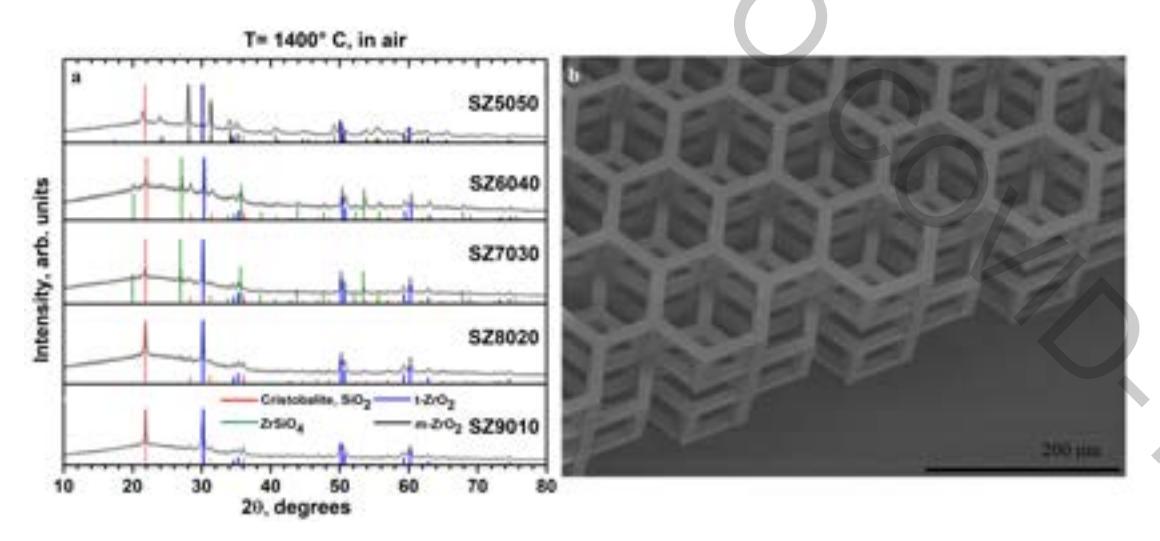
The goal of this study was to investigate the 3D micro-structurability of a series of organic-inorganic polymer precursors and evaluate the effects that annealment has on the fabricated structures. First, a series of silicon and zirconium based hybrid prepolymers SZXY were synthesized via the sol-gel method [3] with a varying molar ratio of silicon (Si) and zirconium (Zr) (X:Y indicate the ratio Si:Zr, the following ratios were tested: 9010, 8020, 7030, 6040, 5050). Secondly, in order to determine the suitability of the prepolymers for laser lithography and the effect of the subsequent heat-treatment, various microstructures were fabricated including woodpiles, solid cubes and resolution bridges. Scanning electron microscopy was used to measure fabricated feature sizes. It was shown that highest resolution is obtained by using a polymer precursor with the least amount of zirconium. It was also found that polymers with a smaller amount of zirconium shrink more during calcination with no significant deformation. In order to determine the crystalline phases that form as a result of the heat-treatment, X-ray diffraction of the polymer powders and micro X-ray diffraction of fabricated hexagonal scaffold structures (Figure 1b) experiments were performed. It can be seen (Figure 1a), that the heat-treatment leads to the formation of four different crystalline phases: cristobalite, zirconium orthosilicate, tetragonal and monoclinic zirconia.
Overall, it can be seen that direct laser writing in conjunction with annealment of various ratios of SZXY is an effective method for the additive manufacturing of 3D glass-ceramic micro-structures. Zirconium orthosilicate and monoclinic zirconia are new material phases that were not observed previously on 3D micro-structures and will probably result in new physical properties to explore.