
One of the most serious worldwide problems is counterfeiting. The forgery of currency, goods or important documents is a huge problem for everyone, including government bodies and big companies. The modern achievements in science and technology create new ways to overcome this serious problem [1]. One of many techniques is security printing.
Luminescent materials emitting in the visible range upon ultraviolet light excitation are used for security printing, holograms, luminescent markers and security labels. All of anti-counterfeiting techniques have advantages and limitations. From this point of view, luminescent materials improved security pigments industry due to their unique optical properties. Usually lanthanides-rich materials are used as luminescent pigments in the security printing.
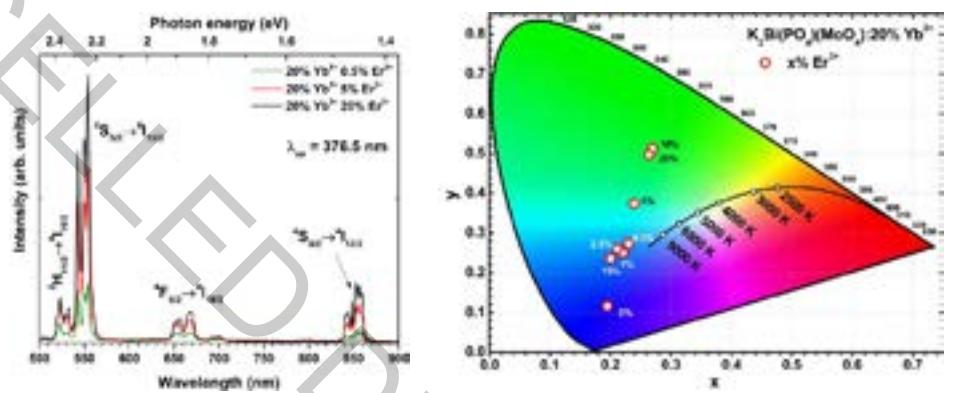
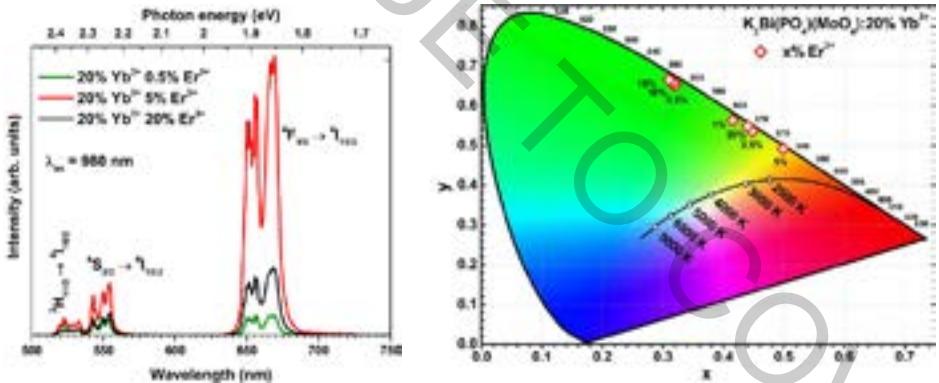
Our recent work represent new inorganic materials for anti-counterfeiting application. The synthesized K2Bi(PO4)(MoO4) host matrix was co-doped with 20% of Yb3+ and different percentage of Er3+. These materials showed good colour saturation, high luminous efficacies, and good quantum efficiencies. Moreover, materials show different emission under 376.5 nm and under 980 nm laser excitation. The most intense 5% Er3+ doped material show green emission under UV light (see Fig. 1) meanwhile sample colour changes to orange-red under laser excitation (see Fig. 2). These features are typical for upconversion materials [2]. Characterization and investigation of the optical properties will be discussed.
This research was funded by a grant (No. D-2018-0703 "Controlling the upconversion emission by tuning band gap of the host matrix") from the Research Council of Lithuania.