
Global warming and environmental damage caused by burning of fossil fuels are increasing world attention to renewable energy sources and one of the most promising is solar energy. Solar energy, which is converted into electricity via different types of solar cells, could theoretically satisfy the energy needs of mankind. Therefore, in many countries, development of technologies utilizing solar energy is stimulated in various ways. Silicon solar cells are currently the most widely used on the market. Because of their high production costs, intensive search of alternatives is underway. One of them is perovskite solar cells, which just in a last decade have become a subject of great interest in the development of next generation solar cells that have already exceeded 25.2% power conversion efficiency [1]. Perovskite solar cells are characterized by simplicity of construction and inexpensive raw materials. Commercialization of the perovskite solar cell technology is hindered by drawbacks which need to be resolved. One of them is that hole transporting organic semiconductor spiro-OMeTAD crystallizes in the device over the time, thus reducing its efficiency [2], furthermore additives are needed to increase the conductivity, which may cause the device degradation. Therefore, the search for new efficient organic semiconductors remains highly relevant.
In this work, new organic semiconductors utilizing one, two, three and four N-carbazolyl chromophores (Fig.1) were synthesized to function as hole transporting materials in perovskite solar cells.
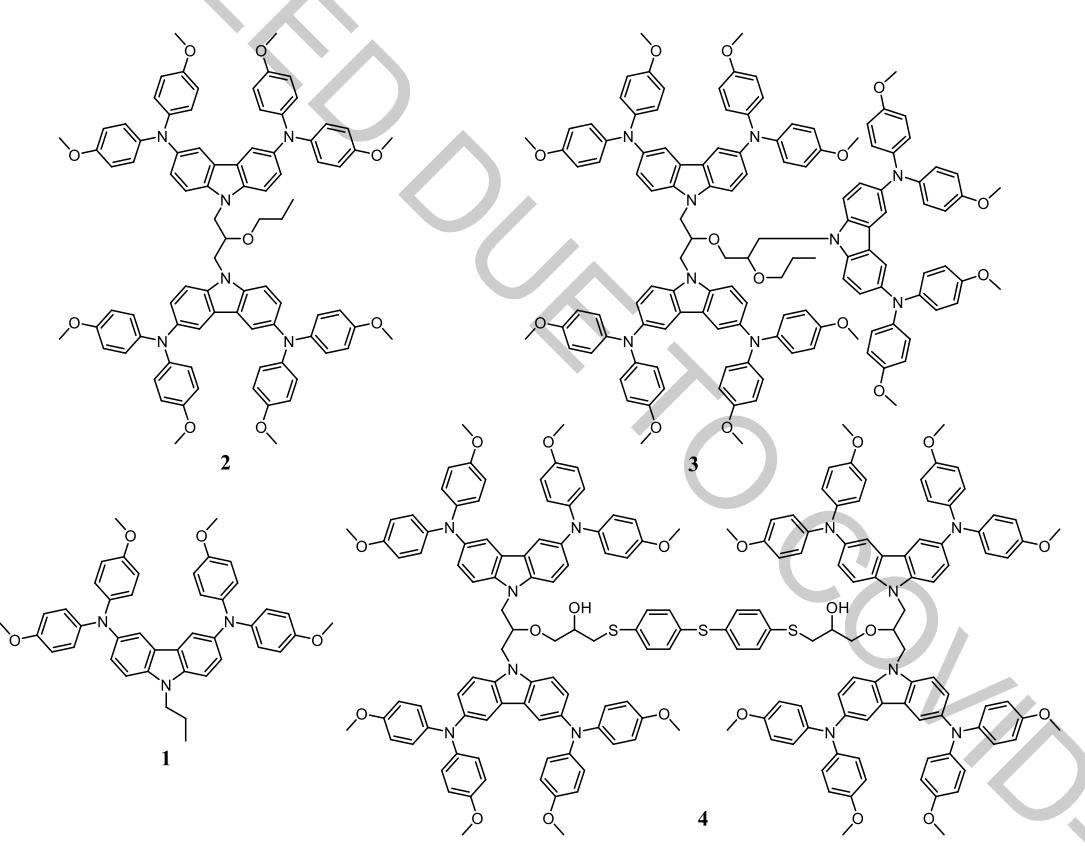
New organic compounds were obtained via step-by-step synthesis. The structure of the newly synthesized semiconductors was confirmed by 1H NMR, 13C NMR and IR spectroscopy. Thermal properties of target compounds proved that they are molecular glasses, demonstrate stable amorphous state and are thermally stable at relatively high temperatures. Ionization potential measurement results (4.92 - 5.16 eV) indicate that the HOMO energy level of the synthesized products is compatible with the valence band of the photoactive perovskite layer. Compounds 2, 3, and 4 exhibit sufficient hole mobility for their use in construction of solar cells.