
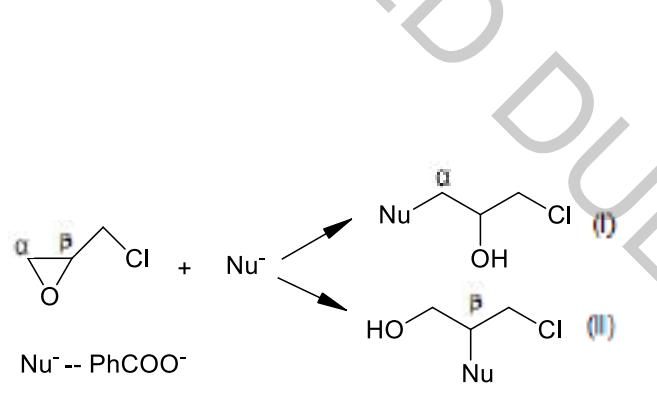
The reaction of oxiranes with proton-donor nucleophilic reagents in the presence of bases is important both for the development of theoretical concepts regarding the reactivity of organic compounds and reaction mechanisms, and for wide practical application, in particular, in the chemistry of polymers. The asymmetric oxirane ring-opening gives "normal"(I) and "abnormal"(II) products. Only product (I) is used for synthesis of epoxy resins.
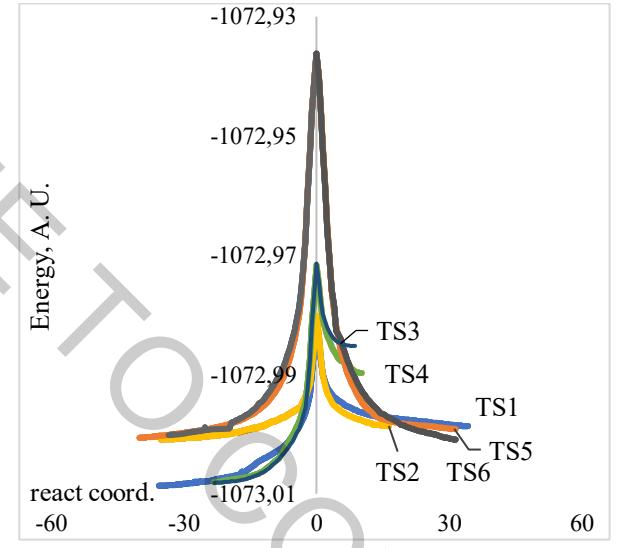
In order to study reaction regioselectivity of the oxirane ring opening by the benzoate-anion of "2-(chloromethyl)oxirane benzoate anion” system a quantum-chemical modeling was utilized [1]. Transition state Z- and E- equilibrium configurations on the reaction path were evaluated for the backside and frontside attack by nucleophile on primary ($\alpha$) and secondary ($\beta$) carbon atoms of 2-(chloromethyl)oxirane. Geometric and activation parameters of possible transition states were established for potential ring-opening ways. Via the values of the fraction of bond formation / cleavage it was shown that transitional states belong to dissociative. The study of stereo- and regioselectivity in the "2-(chloromethyl)oxirane – benzoate anion" reaction system by quantum chemistry revealed that the oxirane ring opening in ($\alpha$) -carbon is energetically favorable (TS2, Fig. 2). It has been established that using of the benzoate anion as a nucleophile provides the SN2 mechanism contribution increase and the "boundary" SN2 mechanism contribution decrease, which leads to the reaction stereoselectivity and regioselectivity increase. The possible directions of nucleophilic attack during the oxirane ring-opening are shown schematically in Fig. 3: backside and/or front attack, and the relative position of benzoate anion and chloromethyl group (Z-and E-configurations).

This statement is confirmed by experimental data [2]. Interaction of 2-(chloromethyl)oxirane with benzoic acid and 3-nitrobenzoic acid (catalyst - tetraethylammonium bromide, N,N-dimethylaniline) results in ca. 89 and 92% of the nomalous product (I) yield.