
Polarization of an arbitrary order can be calculated by expanding density operator in powers of interaction with the excitation field[1]. The resulting optical response theory is not only useful for precise calculations, but also allows one to discover and describe various processes with the help of Feynman diagrams.
The lowest order optical signal that is generated in isotropic media is third order. At this order, the one exciton states and excited state energy transfer can be observed.
When excitation dynamics are followed at the lowest (third) power of interaction to excitation field, dependence on excitation intensity is often ignored. This dependence can be important as laser pulse intensity is one of parameters that is tuned for better signal-noise ratio. At high excitation intensity exciton-exciton annihilation (EEA)[2] takes place. EEA is the process when two molecular excitations, originating from different molecules, meet on the same molecule creating a high energy short lived state. Fast internal conversion takes place and the molecule returns back into singly excited state while the energy of the other excitation gets dissipated in its vibrational manifold. The EEA process in molecular aggregates has the effect of limiting the number of excitations, and can be used to observe exciton migration.
Nonlinear exciton equations (NEE)[3] were used for calculations of spectra. In our previous work spectra were calculated with these equations with EEA terms, but the relaxation model was too primitive and the system of equations was too small. Therefore in this work NEE system of equations is expanded beyond the third order. Secular relaxation and phenomenological EEA terms were added to the equations. Also pump-probe spectra at various excitation intensities were calculated by numerically solving NEE[4].
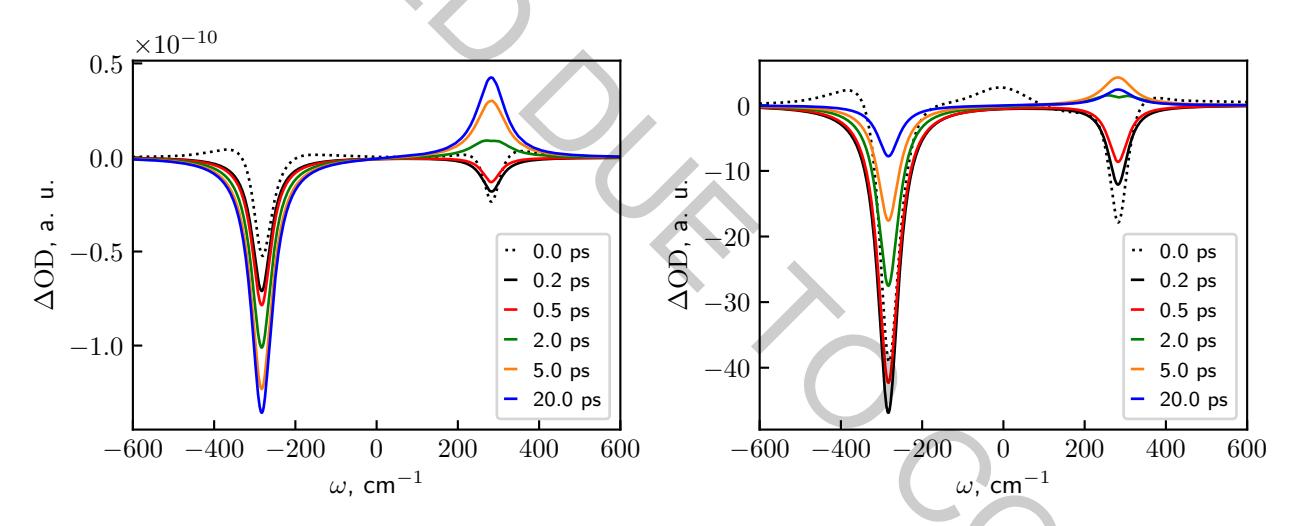
Calculated pump-probe spectra (Fig. 1) for molecular complex show expected relaxation and EEA dynamics: at low excitation intensity pump-probe spectra show excitation transfer, at high excitation intensity spectra amplitudes decay non-exponentially.