Atmospheric aerosol particles have a significant impact on local and global climate and on human health. The studies show that emissions of volatile organic compounds from which aerosol particles are formed are an order of magnitude higher from biogenic sources than anthropogenic [1]. Therefore, organic aerosol makes up a large fraction (20 to 90%) of the submicron particulate mass [2]. To estimate aerosol impact on climate and human health there is a need for identification and evaluation of aerosol sources.
In this study, an aerosol chemical speciation monitor (ACSM) [3] was used to characterize chemical composition of submicron non-refractory PM1 (NR-PM1) aerosol particles. The composition was measured from April to September 2018 at the forest site at the Aukštaitija Integrated Monitoring Station in Rūgšteliškis, eastern part of Lithuania (55.46N; 26.00E). The measurement site is characterized as rural, more than 80% of its area is covered by coniferous trees.
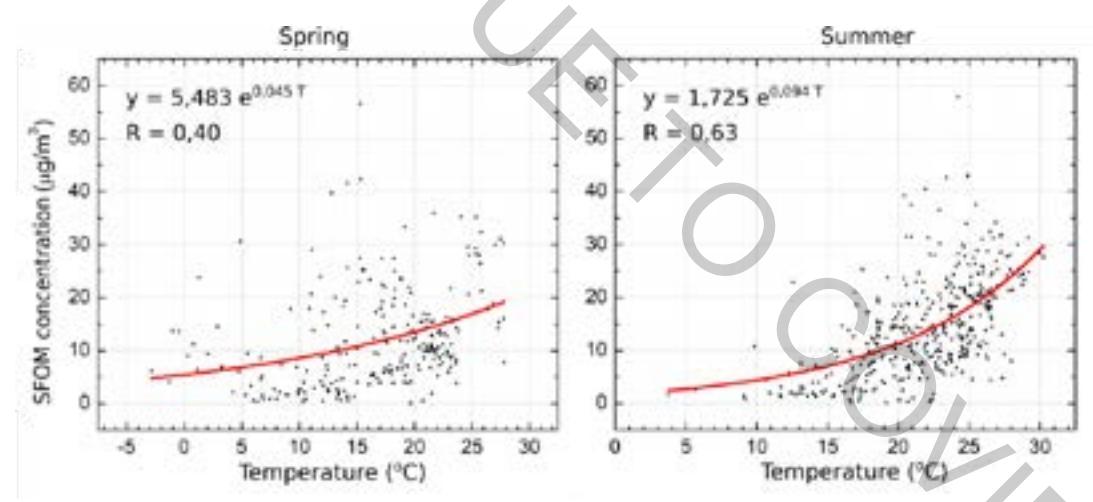
Concentration of five aerosol components (organics, sulphate, ammonium, nitrate and chloride) was evaluated. The contribution of organics to NR-PM1 was dominant and reached 73.5% of the total loading. The sulphate concentration reached 13.7% and was the second largest aerosol component in the forest environment. Submicron forest organic aerosol mass (SFOM) evaluation was also performed. SFOM data was calculated from the concentration of organics using several criteria [1]. Firstly, to eliminate anthropogenic contribution of sulphate from the data set, the time periods with the ratio of organics/(organics + sulphate) > 0.7 were used. Secondly, the time periods corresponding to the SFOM data with average wind speed greater than 1 m s-1 and solar radiation greater than 400 W m-2 were selected [4]. SFOM concentration correlation of 0.63 and 0.40 with temperature was observed in summer and spring, respectively (Fig. 1). In this study, the anthropogenic sulphate aerosol source apportionment was performed using HYSPLIT air mass backward trajectories. An anthropogenic pollution source originating from the West was related to the Klaipėda city port activity.