
Carbon nanomaterials (CNM) such as graphene oxide, carbon nanotubes, fullerenes and nanodiamonds have many promising applications in biomedical technologies [1-4]. The prospects for CNM using in biomedical applications depend on their ability to decompose in organism into products which can be easily eliminated from the body. When they enter the body, CNM interact with immune system parts including neutrophils which are the first cells involved in inflammatory reactions. It was found that the both types of phagocytes (neutrophils and macrophages) can implement slow enzymatic digestion of multi-walled and single-walled nanotubes (MCNTs and SCNMs) for a period of time exceeding several days [4-8]. The purpose of our work was to investigate the effect of carboxylated MCNTs in vitro on activity of human blood neutrophils in the first minutes and hours of their interaction. In order to improve the dispersibility, carbon nanotubes was modifies non-covalently by polyethylene glycol (unionogenic hydrophilic polymer) or deoxyribonucleic acid (anionic polymer).
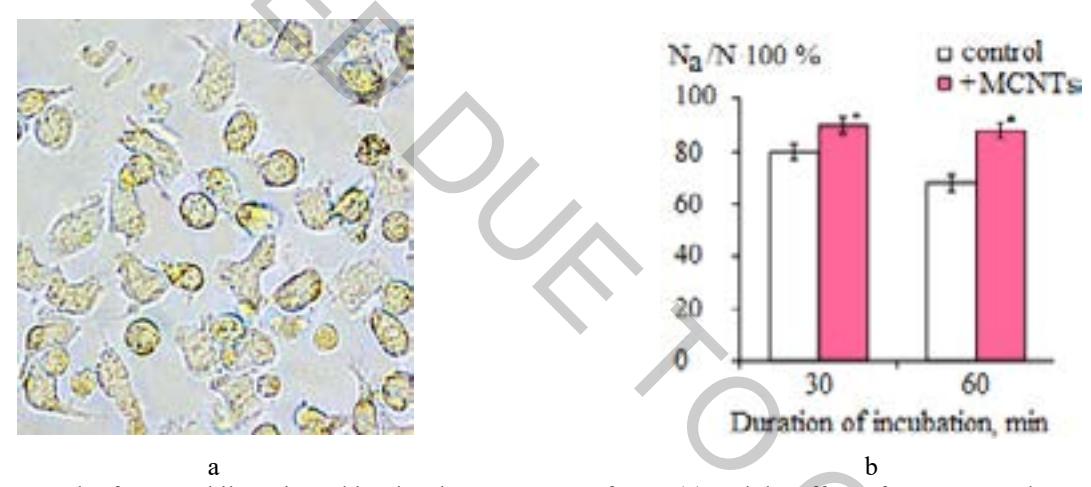
Unactivated neutrophils have a rounded shape, but upon activation they adhere to the surface and spread out, increasing significantly in size (fig. 1, a). The shape of neutrophils upon activation changes greatly and these cells polarize and stretch (fig. 1, a). Neutrophil activation was evaluated by determining the relative content of activated cells ($N_a$) to the total number of cells in the sample (N) with the use of light microscopy method.
An increase in the number of polarized and spread out cells was observed as a result of MCNTs effect during the first hour (fig. 1, b). These findings indicate the activation of neutrophils under MCNTs.
An important indicator of neutrophil activation is the ability to generate reactive oxygen species (ROS), which was studied in the work by the method of luminol-dependent chemiluminescence. Luminol-dependent chemiluminescence of neutrophils is due to the involvement of the myeloperoxidase enzyme (MPO) in the reaction involving ROS. It should be noted that it is MPO that is considered as an enzyme capable of ensuring the destruction of CNTs [4–8].
It was found in our study that initial stimulation of neutrophil ability to generate ROS and luminol-dependent chemiluminescence occurs within 10-30 minutes under the influence of MCNTs. However, with a further increase in the duration of cell contacts with MCNTs, inhibition of neutrophil activity and a decrease in the total yield of ROS are observed.
The obtained data testify that MCNTs can have an initial stimulating effect and a later cytotoxic effect on human neutrophils.