
In order to replace highly effective but costly platinum and rhodium electrocatalysts for hydrogen evolution reaction (HER), nanostructured materials are attracting attention [1] as a possible cost-effective candidate to replace the noble metal electrocatalysts and facilitate the process of water splitting for hydrogen gas production.
In this study, nanostructured MoS2 films were designed on Mo, Ti, Si/SiO2 and Al substrates in attempt to show the influence of substrates on MoS2 nanoplatelet formation. MoS2 nanostructures at various substrates were fabricated via hydrothermal synthesis using a Teflon-lined steel autoclave and a synthesis solution containing thiourea, (NH2)2CS, ammonium heptamolybdate and aniline, $C_6H_5NH_2$. The synthesis reaction was conducted at 220 ± 2 °C for 5 to 15 h.
The obtained nanostructures were examined using SEM. These images (Fig. 1) outline that with the exception of films grown on Si/SiO2 substrate (Fig. 1a), obtained films are of nanosheet morphology (Fig. 1b), however, a gap between the deposited films and Ti and Al substrates are observed (Fig. 1c, d). These substrates are therefore not viable for electrocatalyst fabrication. In contrast, the films fabricated onto the Mo substrate are thicker and better attached to the substrate, as seen in the SEM image (Fig. 1e).
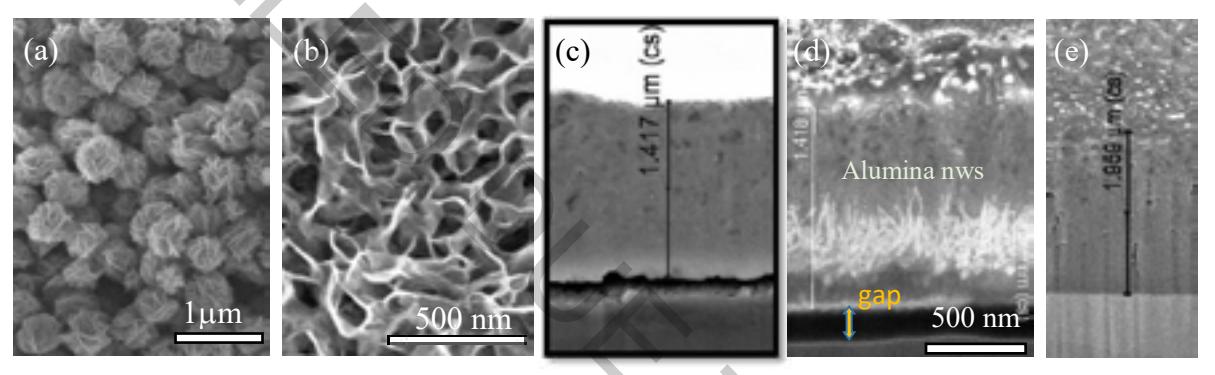
Since MoS2 nanoplatelet films on the Ti substrates were found to be unstable over a long period of HER time, these films were also fabricated onto anodized Ti substrates. MoS2 films deposited on anodized Ti substrates were similar to the ones depicted previously (Fig. 1b), differing in that MoS2 was deposited not solely onto the surface, but also filled titanium nanotubes, inter-tube gaps and cracks, which were formed during the anodizing process. Therefore, these fabricated electocatalysts exhibited much higher HER activity and greatly increased HER stability in acidic solution.
In order to increase both activity and stability of fabricated electrocatalysts, improvements of deposited films as well as anodizing process of Ti substrates are considered.