Metal-free organic materials that show room-temperature phosphorescence (RTP) properties are appropriate replacements to old fashioned organometallic phosphors because of their low cost, suitable optical and environmentally friendly properties, flexible synthesis, and excellent stability. Because of many possible benefits of organic metal-free materials, molecules showing efficient RTP have huge potential for applications in different areas ranging from security, information encryption and optoelectronics to biological probes and optical sensing. [1-4]
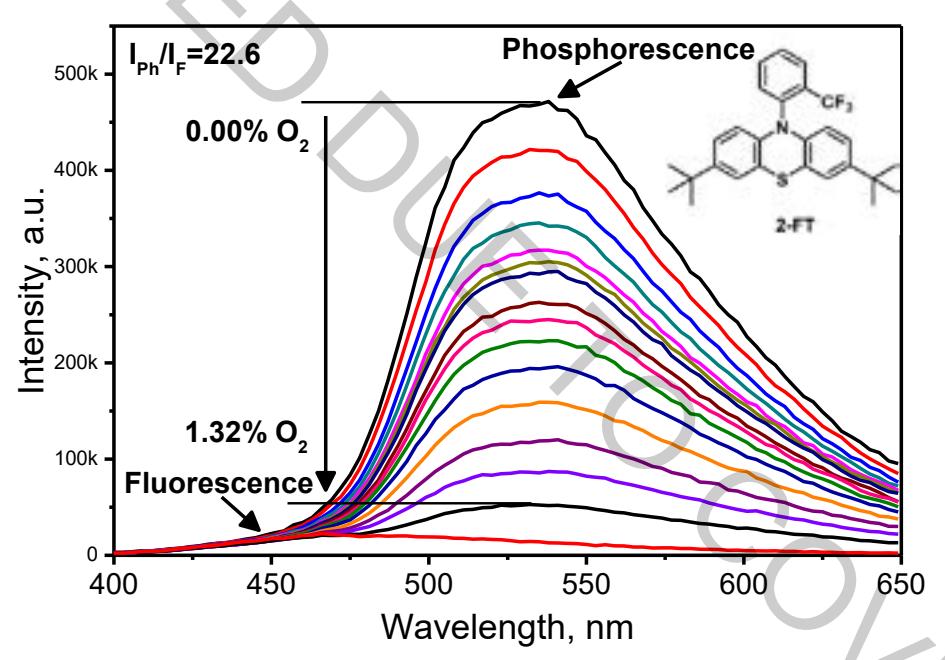
Here we report on a pair of 2- and 4-trifluorobenzene-substituted 3,6-di-tert-butyl-phenothiazine-based derivatives which demonstrate RTP effect. Due to donor-acceptor molecular structure of the synthesized compounds, emission spectra of their solutions have single broad bands resulting from recombination of intramolecular charge transfer excitons. Under inert atmosphere dual emission was detected for solid-state samples (for pure or doped films)
Ratio of RTP to fluorescence ($I_{Ph}/I_F$) were more than 22 which suggesting potential application of phenothiazine-based compounds as active materials for optical sensors of oxygen. Sensitivity of compounds was tested by precise control of N2 and O2 gas flow ratio, they demonstrated excellent sensitivity with minimum threshold of only 0.02% O2 in gas mixture.