
Vibrations energy is one of the biggest unused energy sources in nowadays engineering. This happens, because collecting energy from vibrations is uncommon task and requires non-standard solutions. This paper presents shock absorber construction that has implemented energy generation function and can fulfill vibrations energy generation task.
Vibrations in vehicle appears then vehicle tire contacts road [1]. More then 100 years these vibrations were named as harmful and only solution to avoid them was to absorb the energy and dissipate it as heat. Possibility to collect vibrations energy can lower travel energy costs from 2 % to 10 %, depending on vehicle type [2]. The biggest challenge is to convert energy only few shock absorbers types prevails in researches: Mechanical shock absorbers, where linear movement is changed to rotary by pinion gear [3] and Magnetic absorbers [4].
Our proposed solution is shock absorber with magneto-rheological fluid. Magneto-rheological fluid also known as smart fluid consists of two main elements: oil and magnetic parts. The main feature of smart fluid is that then magnetic field is applied the magnetic parts in fluid organizes and fluid gets thicker. In our case the smart fluid performs three tasks: holds permanent magnetic field for energy generation, lubricates the system and allows to change shock absorbers damping coefficient.
For experimental research were created prototype of shock absorber, which is shown in fig. 1 A. where: 1 – frame; 2 - solenoid coil; 3 – piston stem for force application; 4 – piston; 5 – smart fluid; 6 – fixing eye; 7 – compensating spring; 8 - air piston. This prototype was created for generated energy size determination. Experiments were performed using test rig SPA PSD 2004. Prototype was tested in various regimes applying two different excitation amplitudes: 25 mm and 50mm and frequencies: 1 Hz, 2 Hz, 3 Hz, 4 Hz, 5 Hz, 5,5 Hz, 6 Hz, 6,5 Hz, 7 Hz, 7,5 Hz. Generated voltage was measured in two coils (1st and 3rd from top) obtained results are shown in fig. 1 B.
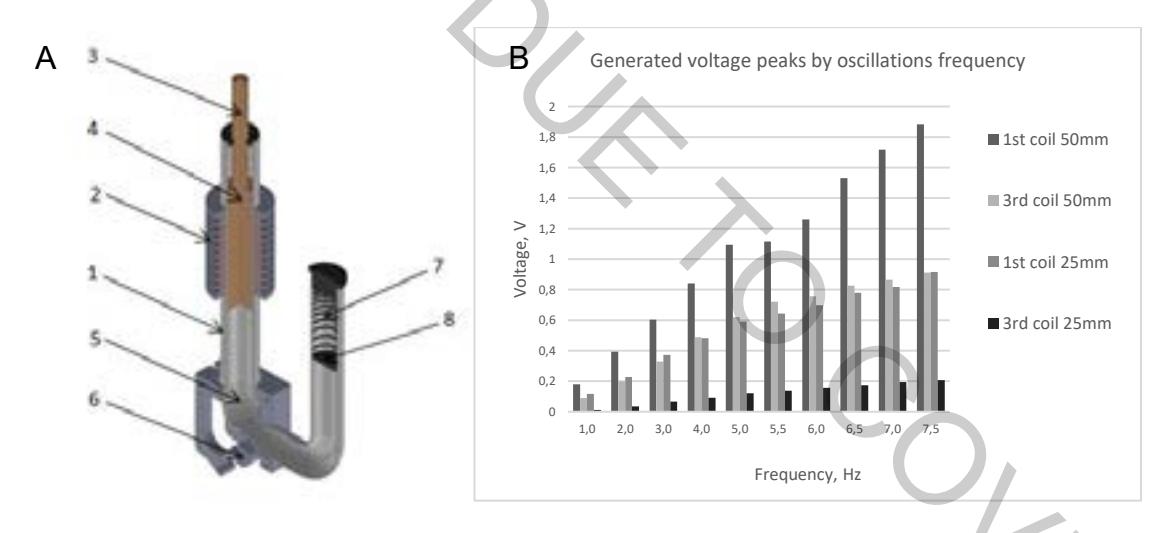
Performed experimental research revealed many interesting effects of implementing such design of the shock absorber. Firstly, this type of liquid core generator can operate and it is really functional. Secondly, obtained voltages are enough high, and this proves that amount of energy harvested from vehicle vibrations is significant and can be used for a variety of purposes, for example powering sensors in autonomous vehicles. In the other hand, many features of this type of electric machines are unknown and need to be further researched.