
Gold nanoclusters (AuNCs) are promising luminescent nanomaterials which consist of several to tens of gold atoms. It's excitation causes the production of cytotoxic reactive oxygen species (ROS), such as hydroxyl radicals (•OH), superoxide anions (O2•−), singlet oxygen (1O2), which induce damage to cellular biomolecules in cancer cells what leads to its destruction [1]. Because of this property they are highly attractive for photodynamic therapy. Combining AuNCs and biomaterials like polymers and proteins can improve the therapeutic properties of nanoparticles, such as their biocompatibility, biodistribution, colloidal stability and lower toxicity. Capping nanostructures with human serum albumin (HSA) which is a non-toxic, stable and biodegradable protein might help to provide necessary properties.
Gold nanoclusters were synthesized according to the previously reported procedure [2] with slight modifications. Filtered and diluted human blood plasma (3.2 mL) was mixed with aqueous NaOH (320 μL, c = 1 M) and HAuCl4 (c = 1.88 × 10⁻² M, 1.8 mL) solutions and the reaction was allowed to proceed under vigorous stirring for 17 h at a temperature of 37 °C. Synthesis were carried out using human blood plasma containing rhesus negative (Rh-) or rhesus positive (Rh+) factor.
Photoluminescence spectrum of human blood plasma proteins stabilized gold nanoclusters solution (${\lambda}_{ex} = 405$ nm) has two bands in the visible region: a main peak with a maximum at 641 nm and another band of lower intensity at 467 nm. Moreover, these gold nanoclusters show considerably longer lifetime (> 1 μs) than that of organic fluorophores (1-5 ns) [3]. Long lifetime of AuNCs is favorable condition for excited particle to interact with surrounding molecules like oxygen and generate reactive oxygen species.
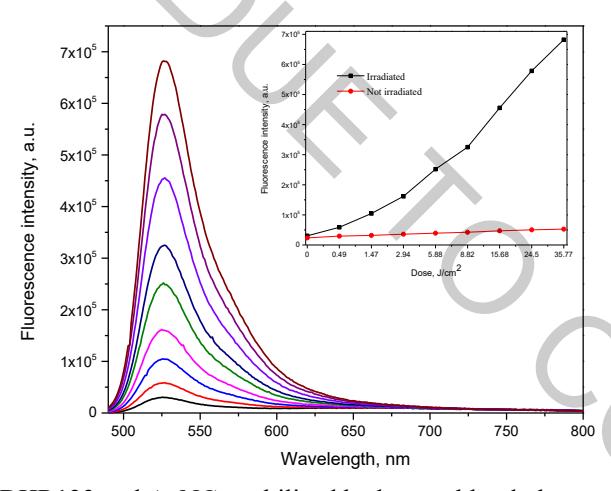
AuNCs potential to generate reactive oxygen species (ROS) was investigated using Dihydrorhodamine 123 (DHR 123). DHR 123 is a non-fluorescent dye that in the presence of reactive oxygen species is oxidized to fluorescent rhodamine. Fig. 1 presents spectra of AuNCs solution with DHR 123 after irradiation with various doses (0 J/cm² to 35 J/cm²) of 405 nm light. Irradiation of solution increases intensity of rhodamine green fluorescence band while not irradiated solution doesn't show significant increase of signal. Observed DHR 123 fluorescence intensity increase was higher for AuNCs stabilized by human blood plasma (Rh-) proteins compared to AuNCs stabilized by human blood plasma (Rh+) proteins.
Our experiments show that AuNCs stabilized by human blood plasma during irradiation generates ROS and can be further investigated as potential photosensitive drugs for photodynamic cancer therapy.