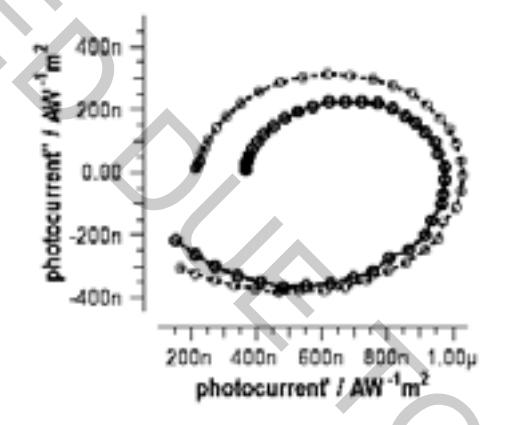
Unlike in Electrochemical Impedance Spectroscopy (EIS), where the applied perturbation is commonly on the electrode potential, the Intensity Modulated Photocurrent Spectroscopy (IMPS) method works by modulating the illumination intensity by a pre-set amplitude (usually $\sim 10\%$ of total intensity) and frequency. For sufficiently photoactive materials, this results in a sinusoidal photocurrent response. Thus, as with EIS, by applying a transfer function the experimental parameters can be projected onto a complex plane as an IMPS spectrum. These spectra can then, in turn, be compared or interpreted to obtain key parameters of the material under investigation: charge transfer and carrier-hole recombination rate constants.
In this study we have prepared WO3 films by electrodeposition from a peroxide-containing solution, at a potential of -0.45 V vs SCE, for different times. Another series of WO3 films was prepared, but with incorporating TiO2 nanoparticles during electrodeposition. All films were annealed at 450°C for 2 hours. The IMPS spectra were measured in 0.5M Na2SO4, under 100 W m-2 illumination intensity (365nm wavelength source), from 10 KHz to 0.1 Hz. Several differences were observed (see Fig. 1). Most notably the low-frequency intercept with the x-axis shifted closer towards 0 with the addition of TiO2, which signifies a change in the recombination or charge transfer kinetics.