
Interest to single molecule spectroscopy and mechanisms of interaction of the light and other energy carriers with isolated molecules has enhanced through last years. However, isolated organic molecules may decompose due to interaction with atmospheric oxidizers, temperature growth and chemical interaction. That's why it is important to distinguish thermal-induced decomposition, radiation-induced and chemical one for accurate experimental measurements, as well as for application of some organic compounds in industry[1].
In modern quantum chemistry a big attention is devoted to studies of organic molecules and compounds and various homologues of wide-known molecules. In this study, authors present an experimental approach in application to fragmentation of organic molecules, evaporated from a Knudsen cell and fragmented with single or multiple charged ions with energies from 2 to 100 kEv. Mass-spectra obtained with a time-of-flight fragment detection method allows to judge about probabilities for possible decomposition reaction channels, while sublimation enthalpy is received due to theoretical treatment. The experiment is held under conditions of vacuum 10-6 Torr, and mass-spectra, showing native and/or fragment peak allows to consider if the process is a kind of thermal decomposition, or ion-induced.
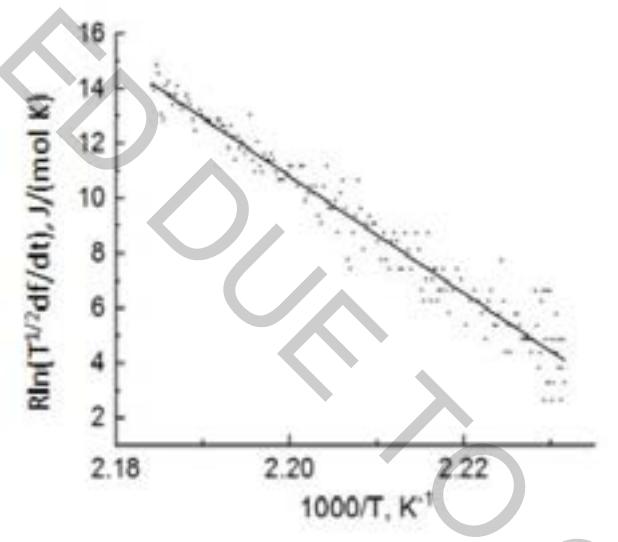
Our treatment is based on pressure, enthalpy and temperature dependence, considered in the Eq (1). Value, obtained from peak information, allow us to receive pressure. Basically, we measure vapor temperature and signal current, associated with concentration of molecules. Enthalpy value is obtained from least squares method for linear dependence of logarithmic pressure from inversed temperature according to Fig. (1).
$$ \ln p = -\frac{\Delta H}{RT} + Const \tag{1} $$Our approach is supposed to be effective for high-energy compounds due to strong vacuum conditions and decomposition control, distinguishing it from other techniques[3] ,which allows to measure sublimation enthalpy of isolated molecules, relevant both for theoretical consideration, and practical application.