
Theoretical description of molecular excitation dynamics is a complex quantum mechanical problem, because interactions between all constituent parts of a molecule have to be considered at an ab-initio level. Therefore, complex quantum chemistry methods exist, which are capable of computing molecular excited state energy levels, transition dipole moments, vibrational mode frequencies, oscillation strengths and other microscopic molecule properties.
Meanwhile, the problem of excitation energy relaxation involves degrees of freedom (DOF) beyond an isolated molecule, requiring to treat the thermal fluctuations of molecule environment, which are an essential aspect of thermodynamically correct excitation energy relaxation modeling. Due to, e.g., internal conversion (IC), a big portion of excitation energy is quickly transformed into molecular vibrational energy (heat), which ought to redistribute among all vibrational DOFs, including those of environment, and, eventually, thermodynamic equilibrium should be restored. Thermal energy redistribution (TER) processes are important in both natural complexes and artificial structures, but due to a large number of interacting DOFs, modeling becomes a challenge. It has been recently demonstrated that this approximation is not accurate for carotenoids and TER processes have to be considered simultaneously [1].
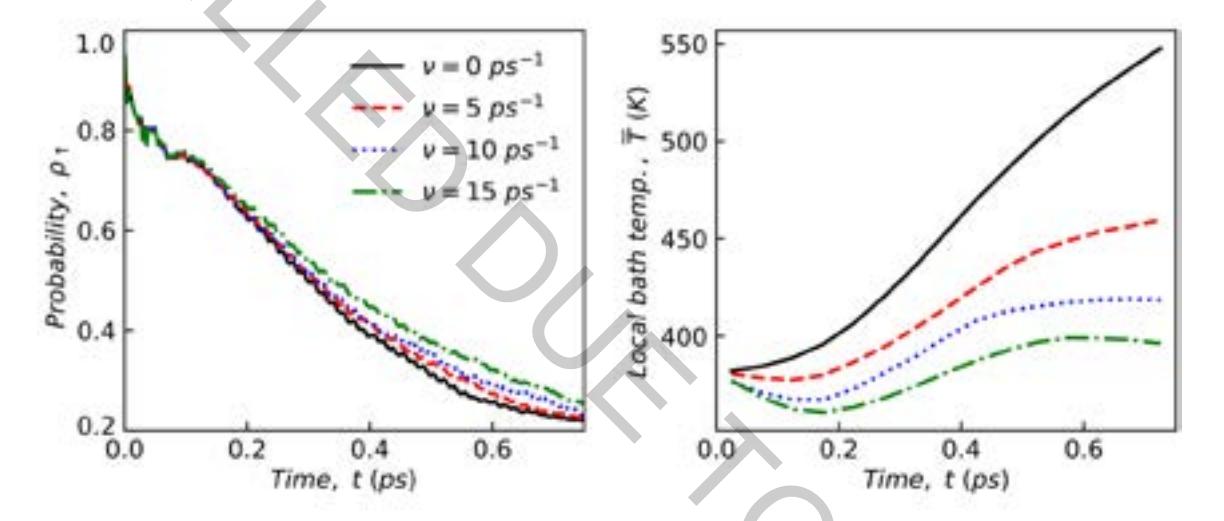
We have created a general purpose molecular IC model where molecular DOFs are treated exactly, while states of environment vibrational DOFs are represented by a superposition of Davydov D2 Ansätze (sD2). A set of equations was derived to calculate the model time evolution. Also, algorithms for considering environment DOFs at a finite temperature and their thermalization, when using the sD2 ansatz, were proposed.
To validate the algorithms, we have considered a model system and have shown that they are capable of maintaining environment DOFs at a finite temperature, even when environment is under the influence of a molecule. Simulations of beta-carotene S2 → S1 IC transition with simultaneous TER processes revealed that beta-carotene IC occurs faster, when the nearest environment temperature increases. Also, that the impact of beta-carotene nearest environment representation by a sD2 wavefunction is minimal.